AWS AppSync is a fully managed service that simplifies the development and deployment of GraphQL APIs. Starting today, AWS AppSync automatically enables encryption at-rest and in-transit for all new API caching configurations. This security enhancement applies to newly created caches, while existing caches maintain their current encryption settings. AWS AppSync SDKs have been updated to enforce encryption for new caches, ignoring any manual encryption configuration attributes.
This default encryption strengthens your GraphQL APIs’ security posture by ensuring comprehensive protection of cached data without requiring additional configuration. The change aligns with AWS security best practices and simplifies the implementation of secure caching for your APIs. Customers can continue using their existing cache configurations without disruption while benefiting from enhanced security for new deployments.
This update is available in all AWS Regions where AWS AppSync is offered. To learn more about AWS AppSync caching, visit our documentation or explore the full range of AWS AppSync features in our Developer Guide.
AWS AppSync is a fully managed service that simplifies the development and deployment of GraphQL APIs. Starting today, AWS AppSync automatically enables encryption at-rest and in-transit for all new API caching configurations. This security enhancement applies to newly created caches, while existing caches maintain their current encryption settings. AWS AppSync SDKs have been updated to enforce encryption for new caches, ignoring any manual encryption configuration attributes. This default encryption strengthens your GraphQL APIs’ security posture by ensuring comprehensive protection of cached data without requiring additional configuration. The change aligns with AWS security best practices and simplifies the implementation of secure caching for your APIs. Customers can continue using their existing cache configurations without disruption while benefiting from enhanced security for new deployments. This update is available in all AWS Regions where AWS AppSync is offered. To learn more about AWS AppSync caching, visit our documentation or explore the full range of AWS AppSync features in our Developer Guide.
Ayudar a los minoristas y a las organizaciones de bienes de consumo a identificar los casos de uso de IA agentica más valiosos
Por Oliver Guy, arquitecto de la industria global, industria minorista y de bienes de consumo de Microsoft
Felice Miller, Líder de Estrategia de Negocios, Cadena de Suministro y Operaciones, Venta Minorista y Bienes de Consumo y Juegos Mundiales, Microsoft
Paul Manikas, arquitecto principal de la industria, entrega de soluciones para la industria, Microsoft
En los últimos 12 meses, las conversaciones con los clientes han pasado de centrarse en la IA generativa a hablar de la IA agéntica. Esta evolución refleja el creciente reconocimiento de los sistemas agénticos para aumentar el potencial de la IA para mejorar los procesos empresariales e impulsar la innovación.
Pero, como ocurre con toda tecnología, determinar por dónde empezar está plagado de dificultades. «Cuando todo lo que tienes es un martillo, todo parece un clavo», o eso dice la expresión, pero cuando se trata de desafíos comerciales, no todos los problemas justifican un enfoque de IA agentiva.
Es posible que ustedes hayan determinado las áreas candidatas para la IA agéntica por medio de un enfoque similar al que describimos cuando discutimos la ideación rápida sobre el valor en un blog anterior. Sin embargo, ¿cómo saber si en verdad justifica un enfoque de agentes, y luego, una vez que estén seguros de que lo hace, cómo determinan el valor que aportará a su organización?
Este blog tiene como objetivo proporcionar orientación sobre cómo abordar estas áreas para empoderarlos para tomar decisiones informadas y desbloquear todo el potencial de la IA agéntica.
Criterios comerciales y técnicos
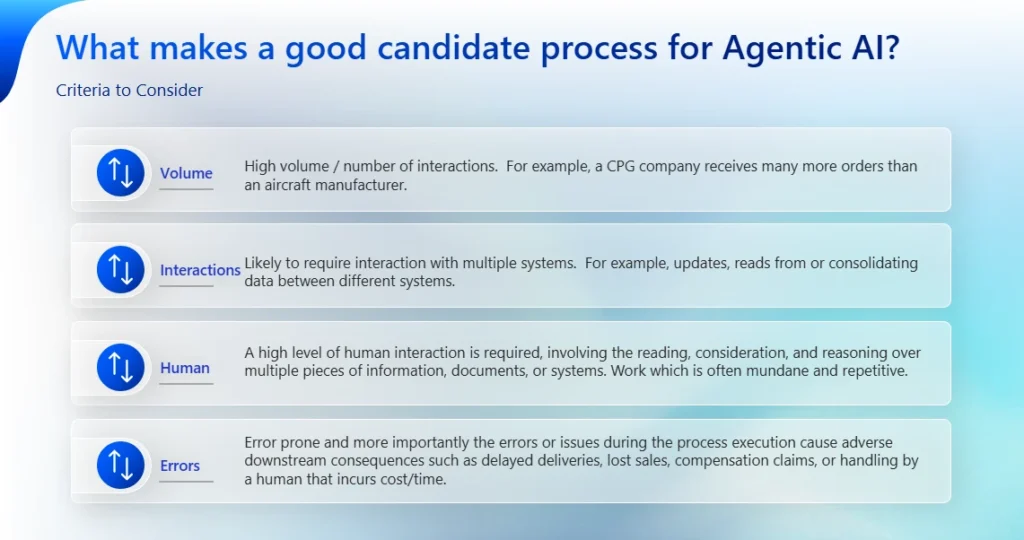
Basándonos en nuestra experiencia de trabajar con empresas minoristas y de bienes de consumo de todo el mundo, existen algunas tendencias comunes que pueden considerarse como criterios para determinar si un proceso específico, o parte de un proceso, es un buen caso de uso para la IA agentica.
Estos no se consideran criterios «estrictos y rápidos» que deben cumplirse, son tan solo pautas.
Volumen. Un proceso con grandes volúmenes o número de interacciones. Por ejemplo, una empresa de bienes de consumo recibe muchos más pedidos que un fabricante de aviones, por lo tanto, es probable que sea mucho más aplicable aplicar la IA agentiva a un proceso de entrada de pedidos en una empresa de bienes de consumo. Eso no significa que la IA agéntica no pueda ayudar a un fabricante de aviones con este proceso. Significa que el elemento de proceso específico donde se aplica sería diferente. Por ejemplo, al realizar un pedido de una aeronave, es posible que se necesiten varios documentos de configuración detallados, y la IA agéntica puede tener un papel valioso para garantizar que esos documentos sean correctos.
Interacción. Un proceso que interactúa con múltiples sistemas. Por ejemplo, actualiza, lee o consolida datos entre diferentes sistemas. Los procesos en los que los usuarios deben revisar, o consolidar, el contenido de varios sistemas son los principales candidatos para la aplicación de la IA agéntica. A veces denominados «integración de silla giratoria», este tipo de procesos son tediosos y están plagados de errores.
Humano. Un proceso en el que se requiere un alto nivel de interacción humana. Tal vez implique buscar, leer, considerar y razonar sobre múltiples piezas de información, documentos o sistemas. Por lo general, se trata de un trabajo mundano y repetitivo. La IA agentica puede evaluar y resaltar brechas, diferencias o anomalías. Puede hacer recomendaciones para que sean evaluadas por un humano y, como tal, está diseñada para trabajar junto o aumentar al ser humano al reducir la cantidad de actividad mundana y repetitiva. El elemento humano es fundamental en este caso: la IA permite que el ser humano se centre en las excepciones, el análisis estratégico y las decisiones complejas, al tiempo que apoya la innovación.
Errores. Procesos que son propensos a errores, lo que a menudo ocurre con operaciones humanas repetitivas y mundanas. Y lo que es más importante, uno en el que cualquier error o problema durante la ejecución del proceso provoca consecuencias adversas en el futuro, como retrasos en las entregas, pérdida de ventas, reclamaciones de indemnización o manipulación por parte de un ser humano que incurra en costes o tiempo. Esta puede ser un área clave de preocupación y enfoque.
Existe un requisito adicional, aunque hay que tenerlo en cuenta a la hora de diseñar una solución. Esto se relaciona con la disponibilidad de datos.
Es fundamental asegurarse de que los datos necesarios para la aplicación de IA agéntica estén disponibles y sean accesibles sin causar desafíos en otros lugares. Es común que los sistemas agénticos necesiten referirse a datos para ayudar a la toma de decisiones. Por ejemplo, puede ser necesario buscar algo en un registro maestro de cliente o proveedor en un sistema transaccional. Cuando muchos de estos se requieren en muy poco tiempo, puede ser que la solución agéntica cause problemas de rendimiento en el sistema transaccional. Desde el punto de vista arquitectónico, este desafío se puede evitar al extraer estos datos en un lago de datos u otro almacén de datos para que actúe como ubicación de referencia.
Definir el valor
Los avances posicionan a la IA agéntica como una piedra angular para crear una cadena de suministro más resiliente, eficiente, sostenible y autónoma. A la hora de evaluar el valor empresarial de cualquier inversión en tecnología, uno de los primeros puntos para tener en cuenta es determinar los impulsores específicos del valor. Además, es de igual importancia entender cómo se va a medir.
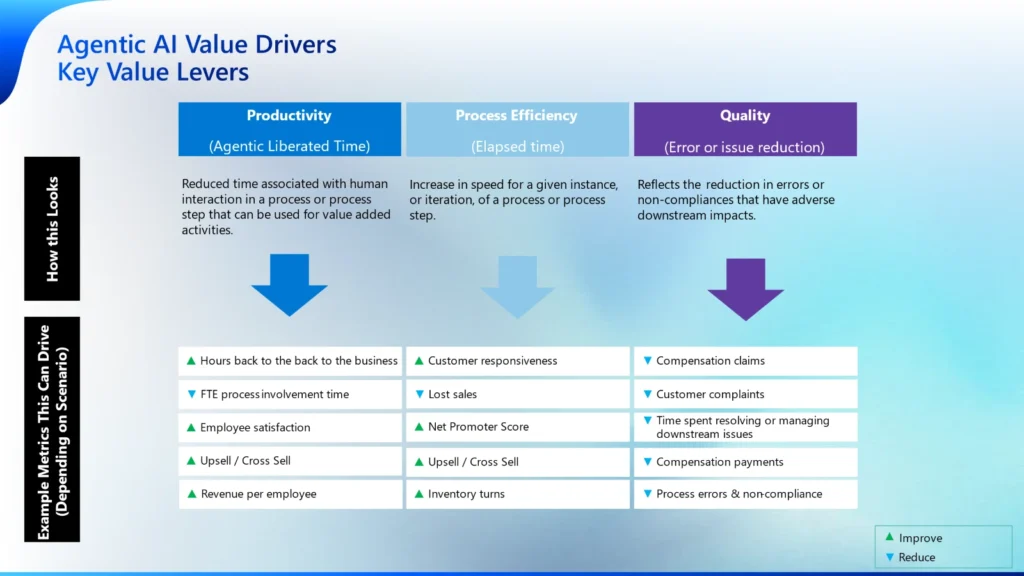
A partir del trabajo que hemos realizado en relación con la IA agéntica, el valor suele dividirse en tres áreas:
Productividad. Puedes pensar en esto como «tiempo liberado agéntico». Esto refleja la reducción del tiempo sin valor agregado asociado con la interacción humana en un proceso o etapa del proceso por medio del «tiempo liberado» para actividades de valor agregado. El alcance de estas actividades adicionales es fundamental para aportar valor a la IA agente. Por ejemplo, un minorista buscaba liberar tiempo para que sus planificadores de la cadena de suministro dedicaran más tiempo a los proveedores individuales que planificaban futuros inventarios promocionales. Los agentes de IA pueden agilizar las comunicaciones con los proveedores, supervisar el cumplimiento de los contratos y resolver disputas de forma eficiente.
Eficiencia del proceso. Esto se relaciona con el tiempo transcurrido que tarda un proceso. Los agentes de IA automatizan las tareas repetitivas y optimizan las operaciones, lo que conduce a mayores niveles de eficiencia de los procesos y menores costes. Esto, a su vez, tiene beneficios secundarios, por ejemplo, reducir el tiempo dedicado entre la recepción y el procesamiento de un pedido de un cliente se traduce en una mejor capacidad de respuesta al cliente.
Calidad. Esto a menudo puede verse como un cliché. Sin embargo, en este caso, el objetivo es la reducción de errores o problemas. En concreto, aquellos que tienen una consecuencia negativa aguas abajo dentro de la organización o la cadena de suministro. Por ejemplo, un inventario prometedor que no existe tendrá un impacto negativo en las puntuaciones de satisfacción del cliente y puede dar lugar a futuras ventas perdidas.
La medición es clave
Para cada una de estas áreas de impulsores de valor, es importante establecer las métricas o KPI que es probable que afectará en su caso específico. El gráfico anterior da algunos ejemplos, pero aquí es donde en verdad entra en vigor el valor de la IA agéntica.
Para el impulsor de valor de la productividad, el tiempo liberado se puede utilizar para identificar oportunidades adicionales de generación de ingresos, lo que puede mejorar su KPI de ingresos por empleado. Para la eficiencia de los procesos, la reducción de las ventas perdidas puede ser una métrica relevante si, por ejemplo, buscan automatizar el proceso de pedidos de sus clientes.
La calidad, sin embargo, es donde se vuelve interesante. Determinar las consecuencias negativas posteriores de una decisión tardía o mal informada puede ser difícil, pero vale la pena. Un enfoque para tener en cuenta es usar Microsoft Copilot para ayudar a idear esto, al pedir sugerencias sobre cuáles podrían ser las consecuencias negativas posteriores de los errores en un proceso en particular. Es posible que esto no arroje la respuesta exacta para su negocio, pero la práctica ha demostrado que por lo general inspira un nuevo pensamiento o perspectiva que se relaciona con su negocio.
Avanzar en el valor
La selección de los casos de uso adecuados para la IA agéntica requiere una comprensión profunda tanto de los criterios de implementación como de los impulsores del valor. Al centrarse en procesos de gran volumen y propensos a errores que requieren un esfuerzo humano significativo y la interacción con múltiples sistemas, las organizaciones pueden identificar las áreas más prometedoras para la aplicación de la IA.
Además, definir y medir el valor de las inversiones en IA a través de la productividad, la eficiencia de los procesos y las mejoras de calidad garantizará que las organizaciones puedan desbloquear todo el potencial de la IA agéntica. Con estas directrices, las organizaciones pueden tomar decisiones informadas y navegar por las complejidades de la selección de casos de uso de IA, lo que en última instancia impulsa la innovación y la eficiencia.
The post Ayudar a los minoristas y a las organizaciones de bienes de consumo a identificar los casos de uso de IA agentica más valiosos appeared first on Source LATAM.
Amazon Managed Streaming for Apache Kafka (Amazon MSK) now supports Apache Kafka version 3.8 on Express Brokers, introducing new features, bug fixes, and performance improvements for Kafka workloads running on Express Brokers. The update brings enhancements in data compression capabilities. You can now configure compression levels for lz4, zstd, and gzip formats, allowing precise control over the balance between compression efficiency and resource usage.
The transition to version 3.8 is straightforward – you can either create new clusters or upgrade your existing ones. For a detailed understanding of the specific improvements and bug fixes included in this release, see the Apache Kafka release notes for version 3.8.
Amazon Managed Streaming for Apache Kafka (Amazon MSK) now supports Apache Kafka version 3.8 on Express Brokers, introducing new features, bug fixes, and performance improvements for Kafka workloads running on Express Brokers. The update brings enhancements in data compression capabilities. You can now configure compression levels for lz4, zstd, and gzip formats, allowing precise control over the balance between compression efficiency and resource usage. The transition to version 3.8 is straightforward – you can either create new clusters or upgrade your existing ones. For a detailed understanding of the specific improvements and bug fixes included in this release, see the Apache Kafka release notes for version 3.8.
Powertools for AWS Lambda now offers a new Amazon Bedrock Agents Function utility that simplifies building serverless applications integrated with Amazon Bedrock Agents. This utility enables developers to easily create AWS Lambda functions that can respond to Amazon Bedrock Agent action requests with built-in parameter injection, response formatting, eliminating boilerplate code and accelerating development.
With the Amazon Bedrock Agents function utility, developers can focus on business logic while the utility handles the complex integration patterns between AWS Lambda and Amazon Bedrock Agents. The utility provides seamless integration with other Powertools features like Logger, Metrics, among other utilities, making it easier to build, test, and deploy production-ready AI applications. This integration significantly improves developer experience when building agent-based solutions that require Lambda functions to process actions requested by Bedrock Agents.
To learn more about the Amazon Bedrock Agents Function utility, visit the Powertools for AWS Lambda documentation (Python, TypeScript, .NET), and explore code examples in our GitHub repository. Get started with this new feature today by updating your Powertools for AWS Lambda dependency to the latest version.
Powertools for AWS Lambda now offers a new Amazon Bedrock Agents Function utility that simplifies building serverless applications integrated with Amazon Bedrock Agents. This utility enables developers to easily create AWS Lambda functions that can respond to Amazon Bedrock Agent action requests with built-in parameter injection, response formatting, eliminating boilerplate code and accelerating development. With the Amazon Bedrock Agents function utility, developers can focus on business logic while the utility handles the complex integration patterns between AWS Lambda and Amazon Bedrock Agents. The utility provides seamless integration with other Powertools features like Logger, Metrics, among other utilities, making it easier to build, test, and deploy production-ready AI applications. This integration significantly improves developer experience when building agent-based solutions that require Lambda functions to process actions requested by Bedrock Agents. To learn more about the Amazon Bedrock Agents Function utility, visit the Powertools for AWS Lambda documentation (Python, TypeScript, .NET), and explore code examples in our GitHub repository. Get started with this new feature today by updating your Powertools for AWS Lambda dependency to the latest version.
You can upgrade with just a few clicks in the Amazon RDS Management Console or by using the AWS SDK or CLI. Learn more about upgrading your database instances from the Amazon RDS Custom User Guide.
This CU is available in all AWS Regions where Amazon RDS Custom for SQL Server is available.
RDS Custom is a managed database service that allows customization of the underlying operating system and database environment. RDS Custom for SQL Server supports two licensing models: License Included (LI) and Bring Your Own Media (BYOM). By using Bring Your Own Media (BYOM), customers can use their existing SQL Server licenses with Amazon RDS Custom for SQL Server. See Amazon RDS Custom Pricing for pricing details and regional availability.
Amazon Relational Database Service (Amazon RDS) Custom for SQL Server now supports Cumulative Update (CU) 18 for Microsoft SQL Server 2022. This update is available for SQL Server Developer, Web, Standard, and Enterprise editions, and includes performance improvements and bug fixes. For more details about the improvements in this update, please review Microsoft KB5050771 release notes.
You can upgrade with just a few clicks in the Amazon RDS Management Console or by using the AWS SDK or CLI. Learn more about upgrading your database instances from the Amazon RDS Custom User Guide.
This CU is available in all AWS Regions where Amazon RDS Custom for SQL Server is available. RDS Custom is a managed database service that allows customization of the underlying operating system and database environment. RDS Custom for SQL Server supports two licensing models: License Included (LI) and Bring Your Own Media (BYOM). By using Bring Your Own Media (BYOM), customers can use their existing SQL Server licenses with Amazon RDS Custom for SQL Server. See Amazon RDS Custom Pricing for pricing details and regional availability.
Amazon Q Developer transformation capabilities now support customization of Java upgrades in Java upgrade transformation CLI (command line interface) with a new selective transformation feature. Using this feature, you can use natural language chat and/or an input file to tailor transformation plans and exercise greater control over Java upgrades. The following options are supported:
Selection of steps from a transformation plan and breakdown of a transformation job for granular code reviews
For first-party and third-party dependencies, the libraries and their versions you would like Q Developer to upgrade during JDK version upgrades
Amazon Q Developer Java upgrade capabilities now have been tested to offer enhanced transformation success rates, reducing the manual effort needed to complete your software modernization tasks.
The selective transformation feature for Java upgrades is available in the command line, on Linux and MacOS. To learn more and get started, please visit the documentation page.
Amazon Q Developer transformation capabilities now support customization of Java upgrades in Java upgrade transformation CLI (command line interface) with a new selective transformation feature. Using this feature, you can use natural language chat and/or an input file to tailor transformation plans and exercise greater control over Java upgrades. The following options are supported:
Selection of steps from a transformation plan and breakdown of a transformation job for granular code reviews
For first-party and third-party dependencies, the libraries and their versions you would like Q Developer to upgrade during JDK version upgrades
Amazon Q Developer Java upgrade capabilities now have been tested to offer enhanced transformation success rates, reducing the manual effort needed to complete your software modernization tasks. The selective transformation feature for Java upgrades is available in the command line, on Linux and MacOS. To learn more and get started, please visit the documentation page.
Amazon Elastic VMware Service (Amazon EVS), an AWS service that enables you to run VMware Cloud Foundation (VCF) within your Amazon Virtual Private Cloud, now integrates with Amazon FSx for NetApp ONTAP, a fully managed AWS service built on NetApp’s ONTAP file system. With this integration, Amazon EVS customers can use FSx for ONTAP as a scalable, high-performance external datastore for their VCF environments on AWS, enabling them to benefit from cost savings through independent scaling of storage and compute, and automated data tiering. If you’re running VMware with ONTAP on-premises, you can use the same tools and workflows to easily migrate those workloads to AWS and maintain operational consistency.
NetApp ONTAP is commonly used as the underlying storage for VMware workloads like databases, Virtual Desktop Infrastructure (VDI), and line-of-business applications due to its advanced data management features such as snapshots, clones, replication, and storage efficiencies. With this integration, you can improve agility and reduce costs by scaling storage independently from compute, improve data protection, and further optimize costs with automated data tiering to low-cost storage and storage efficiencies. And, you can now migrate and extend your VMware workloads easily to AWS while leveraging the same data management capabilities.
The Amazon EVS integration with FSx for ONTAP is now available for public preview in all AWS Regions where both Amazon EVS and FSx for ONTAP are available. To get started, visit the Amazon EVS website. For more information, visit the FSx for ONTAP documentation.
Amazon Elastic VMware Service (Amazon EVS), an AWS service that enables you to run VMware Cloud Foundation (VCF) within your Amazon Virtual Private Cloud, now integrates with Amazon FSx for NetApp ONTAP, a fully managed AWS service built on NetApp’s ONTAP file system. With this integration, Amazon EVS customers can use FSx for ONTAP as a scalable, high-performance external datastore for their VCF environments on AWS, enabling them to benefit from cost savings through independent scaling of storage and compute, and automated data tiering. If you’re running VMware with ONTAP on-premises, you can use the same tools and workflows to easily migrate those workloads to AWS and maintain operational consistency. NetApp ONTAP is commonly used as the underlying storage for VMware workloads like databases, Virtual Desktop Infrastructure (VDI), and line-of-business applications due to its advanced data management features such as snapshots, clones, replication, and storage efficiencies. With this integration, you can improve agility and reduce costs by scaling storage independently from compute, improve data protection, and further optimize costs with automated data tiering to low-cost storage and storage efficiencies. And, you can now migrate and extend your VMware workloads easily to AWS while leveraging the same data management capabilities. The Amazon EVS integration with FSx for ONTAP is now available for public preview in all AWS Regions where both Amazon EVS and FSx for ONTAP are available. To get started, visit the Amazon EVS website. For more information, visit the FSx for ONTAP documentation.
Today, AWS is expanding access to Amazon Elastic VMware Service (Amazon EVS) through public preview. Building on the momentum from the initial private preview announcement at AWS re:Invent 2024, public preview opens access for AWS customers who want to run VMware Cloud Foundation (VCF)-based workloads within their Amazon Virtual Private Cloud (Amazon VPC).
During public preview, you can leverage VCF license portability entitlements and migrate non-production workloads to Amazon EVS. You can provision and configure your environment through a guided workflow and automatically deploy a fully-functional VCF environment on AWS. Amazon EVS allows you to bring in familiar VCF tools and external storage solutions, including Amazon FSx for NetApp ONTAP, to meet the unique demands of your applications and optimize your virtualization stack in the cloud. At this time, Amazon EVS supports VCF version 5.2.1 and running workloads on i4i.metal instances. You can expect to have the same easy-to-use console interface and functionality at general availability. Additionally, any environments deployed during the public preview will carry forward without redeployment as the service moves into general availability.
The public preview of Amazon EVS is currently available in five Regions: US East (N. Virginia), US East (Ohio), US West (Oregon), Asia Pacific (Tokyo), and Europe (Frankfurt).
Today, AWS is expanding access to Amazon Elastic VMware Service (Amazon EVS) through public preview. Building on the momentum from the initial private preview announcement at AWS re:Invent 2024, public preview opens access for AWS customers who want to run VMware Cloud Foundation (VCF)-based workloads within their Amazon Virtual Private Cloud (Amazon VPC).
During public preview, you can leverage VCF license portability entitlements and migrate non-production workloads to Amazon EVS. You can provision and configure your environment through a guided workflow and automatically deploy a fully-functional VCF environment on AWS. Amazon EVS allows you to bring in familiar VCF tools and external storage solutions, including Amazon FSx for NetApp ONTAP, to meet the unique demands of your applications and optimize your virtualization stack in the cloud. At this time, Amazon EVS supports VCF version 5.2.1 and running workloads on i4i.metal instances. You can expect to have the same easy-to-use console interface and functionality at general availability. Additionally, any environments deployed during the public preview will carry forward without redeployment as the service moves into general availability.
The public preview of Amazon EVS is currently available in five Regions: US East (N. Virginia), US East (Ohio), US West (Oregon), Asia Pacific (Tokyo), and Europe (Frankfurt).
Access Amazon EVS on the AWS console. Learn more about Amazon EVS on the product page and user guide.
AWS Glue, a serverless data integration service, is now available in the Asia Pacific (Taipei) region, enabling customers to build and run their ETL workloads closer to their data sources in these regions.
AWS Glue is a serverless data integration service that makes it simple to discover, prepare, and combine data for analytics, machine learning, and application development. AWS Glue provides both visual and code-based interfaces to make data integration simpler, so you can analyze your data and put it to use in minutes.
AWS Glue, a serverless data integration service, is now available in the Asia Pacific (Taipei) region, enabling customers to build and run their ETL workloads closer to their data sources in these regions. AWS Glue is a serverless data integration service that makes it simple to discover, prepare, and combine data for analytics, machine learning, and application development. AWS Glue provides both visual and code-based interfaces to make data integration simpler, so you can analyze your data and put it to use in minutes. To learn more, visit the AWS Glue product page and our documentation. For AWS Glue region availability, please see the AWS Region table.
Amazon Elastic File System (EFS) now supports Internet Protocol Version 6 (IPv6) for both EFS APIs and mount targets, enabling customers to manage and mount file systems using IPv4, IPv6, or dual-stack clients.
This launch helps customers meet IPv6 compliance requirements and eliminates the need for complex infrastructure to handle IPv6 to IPv4 address translation. Customers can now use IPv6 clients to access EFS APIs through new dual-stack endpoints. Additionally, customers can mount file systems using IPv6 by specifying an IP address type when creating mount targets.
EFS offers IPv6 support in all AWS Commercial and the AWS GovCloud (US) Regions. To get started using IPv6 on EFS, refer to the EFS user guide.
Amazon Elastic File System (EFS) now supports Internet Protocol Version 6 (IPv6) for both EFS APIs and mount targets, enabling customers to manage and mount file systems using IPv4, IPv6, or dual-stack clients. This launch helps customers meet IPv6 compliance requirements and eliminates the need for complex infrastructure to handle IPv6 to IPv4 address translation. Customers can now use IPv6 clients to access EFS APIs through new dual-stack endpoints. Additionally, customers can mount file systems using IPv6 by specifying an IP address type when creating mount targets. EFS offers IPv6 support in all AWS Commercial and the AWS GovCloud (US) Regions. To get started using IPv6 on EFS, refer to the EFS user guide.