Publicado el Deja un comentario

Announcing EKS Dashboard, a multi-cluster view of Kubernetes infrastructure across AWS Regions and your AWS Organizations

Amazon Elastic Kubernetes Service (EKS) announces the general availability of EKS Dashboard, a new feature that provides centralized visibility into Kubernetes infrastructure across multiple AWS Regions and accounts. EKS Dashboard provides comprehensive insights into your Kubernetes clusters, enabling operational planning and governance. You can access the Dashboard in EKS console through AWS Organizations’ management and delegated administrator accounts.

As you expand your Kubernetes footprint to address operational and strategic objectives, such as improving availability, ensuring business continuity, isolating workloads, and scaling infrastructure, the EKS Dashboard provides centralized visibility across your Kubernetes infrastructure. You can now visualize your entire Kubernetes infrastructure without switching between AWS Regions or accounts, gaining aggregated insights into clusters, managed node groups, and EKS add-ons. This includes clusters running specific Kubernetes versions, support status, upcoming end of life auto-upgrades, managed node group AMI versions, EKS add-on versions, and more. This centralized approach supports more effective oversight, auditability, and operational planning for your Kubernetes infrastructure.

The EKS Dashboard can be accessed in the us-east-1 AWS Region, aggregating EKS cluster metadata from all commercial AWS Regions. To get started, see the EKS user guide.


 

​Amazon Elastic Kubernetes Service (EKS) announces the general availability of EKS Dashboard, a new feature that provides centralized visibility into Kubernetes infrastructure across multiple AWS Regions and accounts. EKS Dashboard provides comprehensive insights into your Kubernetes clusters, enabling operational planning and governance. You can access the Dashboard in EKS console through AWS Organizations’ management and delegated administrator accounts. As you expand your Kubernetes footprint to address operational and strategic objectives, such as improving availability, ensuring business continuity, isolating workloads, and scaling infrastructure, the EKS Dashboard provides centralized visibility across your Kubernetes infrastructure. You can now visualize your entire Kubernetes infrastructure without switching between AWS Regions or accounts, gaining aggregated insights into clusters, managed node groups, and EKS add-ons. This includes clusters running specific Kubernetes versions, support status, upcoming end of life auto-upgrades, managed node group AMI versions, EKS add-on versions, and more. This centralized approach supports more effective oversight, auditability, and operational planning for your Kubernetes infrastructure. The EKS Dashboard can be accessed in the us-east-1 AWS Region, aggregating EKS cluster metadata from all commercial AWS Regions. To get started, see the EKS user guide.  

Publicado el Deja un comentario

Amazon EC2 Mac instances now support configurable System Integrity Protection (SIP) settings

Starting today, customers can now configure System Integrity Protection (SIP) settings on their EC2 Mac instances, providing greater flexibility and control over their development environments. SIP is a critical macOS security feature that helps prevent unauthorized code execution and system-level modifications. This enhancement enables developers to temporarily disable SIP for development and testing purposes, install and validate system extensions and DriverKit drivers, optimize testing performance through selective program management, and maintain security compliance while meeting development requirements.

The new SIP configuration capability is available across all EC2 Mac instance families, including both Intel (x86) and Apple silicon platforms. Customers can access this feature in all AWS regions where EC2 Mac instances are currently supported. To learn more about this feature, please visit the documentation here and our launch blog here. To learn more about EC2 Mac instances, click here.


​Starting today, customers can now configure System Integrity Protection (SIP) settings on their EC2 Mac instances, providing greater flexibility and control over their development environments. SIP is a critical macOS security feature that helps prevent unauthorized code execution and system-level modifications. This enhancement enables developers to temporarily disable SIP for development and testing purposes, install and validate system extensions and DriverKit drivers, optimize testing performance through selective program management, and maintain security compliance while meeting development requirements. The new SIP configuration capability is available across all EC2 Mac instance families, including both Intel (x86) and Apple silicon platforms. Customers can access this feature in all AWS regions where EC2 Mac instances are currently supported. To learn more about this feature, please visit the documentation here and our launch blog here. To learn more about EC2 Mac instances, click here.  

Publicado el Deja un comentario

AWS Cost Anomaly Detection enables advanced alerting through AWS User Notifications

AWS Cost Anomaly Detection now integrates with AWS User Notifications (via Amazon EventBridge), enabling customers to create enhanced alerting capabilities in the AWS User Notifications console. This integration lets customers configure sophisticated alert rules based on service, account, or other cost dimensions to identify and respond to unexpected spending changes faster. Using AWS User Notifications, customers can receive immediate or aggregated alerts through multiple channels including email, AWS Chatbot, and the AWS Console Mobile Application, while maintaining a centralized history of alert notifications.

This new capability allow customers to customize their cost monitoring by creating alert rules in AWS User Notifications. Now customers can configure rules with higher thresholds for machine learning services that naturally experience cost spikes during training, while setting lower thresholds for stable services like databases where small changes might indicate configuration issues. Customers also benefit from verified contact management, ensuring alerts reach the right teams through validated delivery channels that can be reused across multiple alert configurations.

These enhancements are available in all AWS Regions, except the AWS GovCloud (US) Regions and the China Regions. To learn more about setting up alerts in AWS User Notifications and getting started, visit the AWS Cost Anomaly Detection product page and documentation.


​AWS Cost Anomaly Detection now integrates with AWS User Notifications (via Amazon EventBridge), enabling customers to create enhanced alerting capabilities in the AWS User Notifications console. This integration lets customers configure sophisticated alert rules based on service, account, or other cost dimensions to identify and respond to unexpected spending changes faster. Using AWS User Notifications, customers can receive immediate or aggregated alerts through multiple channels including email, AWS Chatbot, and the AWS Console Mobile Application, while maintaining a centralized history of alert notifications. This new capability allow customers to customize their cost monitoring by creating alert rules in AWS User Notifications. Now customers can configure rules with higher thresholds for machine learning services that naturally experience cost spikes during training, while setting lower thresholds for stable services like databases where small changes might indicate configuration issues. Customers also benefit from verified contact management, ensuring alerts reach the right teams through validated delivery channels that can be reused across multiple alert configurations. These enhancements are available in all AWS Regions, except the AWS GovCloud (US) Regions and the China Regions. To learn more about setting up alerts in AWS User Notifications and getting started, visit the AWS Cost Anomaly Detection product page and documentation.    

Publicado el Deja un comentario

AWS DMS introduces Data Resync for improved migration accuracy

AWS Database Migration Service (AWS DMS) now supports Data Resync, a new feature that automatically corrects data inconsistencies identified during validation between source and target databases.

Data Resync integrates with your existing DMS migration tasks and supports both Full Load and Change Data Capture (CDC) phases. It uses your current task settings—including connection configurations, table mappings, and transformations—to apply corrections automatically, helping ensure accurate and reliable migrations without manual intervention. With Data Resync, AWS DMS can detect and resolve common data issues, such as missing records, duplicate entries, or mismatched values, based on validation results.

Data Resync is available starting with AWS DMS replication engine version 3.6.1, and currently supports migration paths from Oracle and SQL Server to PostgreSQL. For detailed information on how Data Resync enhances migration accuracy, please refer to the AWS DMS Technical Documentation.


​AWS Database Migration Service (AWS DMS) now supports Data Resync, a new feature that automatically corrects data inconsistencies identified during validation between source and target databases. Data Resync integrates with your existing DMS migration tasks and supports both Full Load and Change Data Capture (CDC) phases. It uses your current task settings—including connection configurations, table mappings, and transformations—to apply corrections automatically, helping ensure accurate and reliable migrations without manual intervention. With Data Resync, AWS DMS can detect and resolve common data issues, such as missing records, duplicate entries, or mismatched values, based on validation results. Data Resync is available starting with AWS DMS replication engine version 3.6.1, and currently supports migration paths from Oracle and SQL Server to PostgreSQL. For detailed information on how Data Resync enhances migration accuracy, please refer to the AWS DMS Technical Documentation.  

Publicado el Deja un comentario

Amazon RDS now supports easy retrieval of engine lifecycle support dates

Amazon RDS announces a new capability that helps you view engine lifecycle support dates for your databases. This new feature provides a centralized and convenient place to access engine support dates, offering greater control over your database lifecycle management

You can view start and end dates for RDS Standard Support and RDS Extended Support for RDS and Aurora major engine versions through the RDS API or AWS CLI. If RDS Extended Support is available for an engine version then both RDS Standard and Extended Support dates are shown. If RDS Extended Support is not available for an engine version, the response includes only RDS Standard Support dates

With this feature you can view lifecycle support dates for RDS MySQL, RDS MariaDB, RDS PostgreSQL, Aurora MySQL, and Aurora PostgreSQL engines. To learn more, visit Amazon RDS User Guide and Amazon Aurora User Guide.

Amazon RDS makes it simple to set up, operate, and scale database deployments in the cloud. Create or update a fully managed Amazon RDS database in the Amazon RDS Management Console.

Amazon Aurora is designed for unparalleled high performance and availability at global scale with full MySQL and PostgreSQL compatibility. To get started with Amazon Aurora, take a look at our getting started page.


​Amazon RDS announces a new capability that helps you view engine lifecycle support dates for your databases. This new feature provides a centralized and convenient place to access engine support dates, offering greater control over your database lifecycle management You can view start and end dates for RDS Standard Support and RDS Extended Support for RDS and Aurora major engine versions through the RDS API or AWS CLI. If RDS Extended Support is available for an engine version then both RDS Standard and Extended Support dates are shown. If RDS Extended Support is not available for an engine version, the response includes only RDS Standard Support dates With this feature you can view lifecycle support dates for RDS MySQL, RDS MariaDB, RDS PostgreSQL, Aurora MySQL, and Aurora PostgreSQL engines. To learn more, visit Amazon RDS User Guide and Amazon Aurora User Guide. Amazon RDS makes it simple to set up, operate, and scale database deployments in the cloud. Create or update a fully managed Amazon RDS database in the Amazon RDS Management Console. Amazon Aurora is designed for unparalleled high performance and availability at global scale with full MySQL and PostgreSQL compatibility. To get started with Amazon Aurora, take a look at our getting started page.  

Publicado el Deja un comentario

AWS Deadline Cloud now supports Foundry Nuke version 16

Starting today, AWS Deadline Cloud will support the latest version of Foundry Nuke, a powerful compositing tool widely used for visual effects and post-production workflows. AWS Deadline Cloud is a fully managed service that simplifies render management for teams creating computer-generated graphics and visual effects, for films, television and broadcasting, web content, and design.

With support for Nuke version 16, you can access the latest improvements for Nuke while leveraging AWS Deadline Cloud’s managed infrastructure for your rendering pipelines, giving you the ability to create high-quality content using cutting-edge compositing features.

This new version is now available in all AWS regions where AWS Deadline Cloud is currently offered. To learn more about AWS Deadline Cloud and how to leverage Nuke version 16 in your workflows, visit the AWS Deadline Cloud documentation.


​Starting today, AWS Deadline Cloud will support the latest version of Foundry Nuke, a powerful compositing tool widely used for visual effects and post-production workflows. AWS Deadline Cloud is a fully managed service that simplifies render management for teams creating computer-generated graphics and visual effects, for films, television and broadcasting, web content, and design. With support for Nuke version 16, you can access the latest improvements for Nuke while leveraging AWS Deadline Cloud’s managed infrastructure for your rendering pipelines, giving you the ability to create high-quality content using cutting-edge compositing features. This new version is now available in all AWS regions where AWS Deadline Cloud is currently offered. To learn more about AWS Deadline Cloud and how to leverage Nuke version 16 in your workflows, visit the AWS Deadline Cloud documentation.    

Publicado el Deja un comentario

Presentamos GPT-image-1: Alcanzar nuevas alturas con la generación de imágenes en Azure AI Foundry

mayo 21, 2025

Presentamos GPT-image-1: Alcanzar nuevas alturas con la generación de imágenes en Azure AI Foundry

Pantalla de computadora con un mouse y un mouse pad

Por Steve Sweetman, jefe de producto del servicio Azure OpenAI.

Estamos encantados de anunciar el lanzamiento de GPT-image-1, el último y más avanzado modelo de generación de imágenes. Nuestra API ya está disponible para todos los clientes cerrados: aplicación de modelo de acceso limitado y patio de recreo llegará más adelante. Este modelo innovador establece un nuevo estándar en la generación de imágenes de alta calidad, la resolución de prompts complejos y la oferta de capacidades de disparo cero en varios escenarios.

Creen soluciones personalizadas de IA generativa

Eso es suficiente texto para describir un modelo de generación de imágenes por ahora: miren el video a continuación y observen a GPT-image-1 en acción:

Características clave y mejoras

GPT-image-1 se basa en los puntos fuertes de su predecesor, DALL-E, con importantes mejoras:

  • Respuesta de instrucciones granulares: GPT-image-1 sobresale en la comprensión y ejecución de instrucciones detalladas, lo que garantiza una generación de imágenes precisa y precisa.
  • Representación de texto: El modelo representa de forma fiable el texto dentro de las imágenes, lo que mejora su utilidad en la creación de materiales educativos y libros de cuentos.
  • Aceptación de entrada de imágenes: Los usuarios pueden cargar imágenes y proporcionar indicaciones de texto para generar nuevas imágenes o editar las existentes, lo que ofrece una herramienta versátil para proyectos creativos.
Una casa abierta virtual con una habitación que tiene un sofá y una ventana

Capacidades de GPT-image-1

GPT-image-1 admite múltiples modalidades y características:

  • Text-to-image: Generen imágenes a partir de prompts de texto, similar a text2im en ChatGPT DALL-E.
  • Imagen a imagen: Creen nuevas imágenes a partir de imágenes cargadas por el usuario y mensajes de texto, una función que no está disponible en ChatGPT DALL-E.
  • Transformación de texto: Editen imágenes por medio de prompts de texto, similar a la función de transformación en ChatGPT DALL-E.
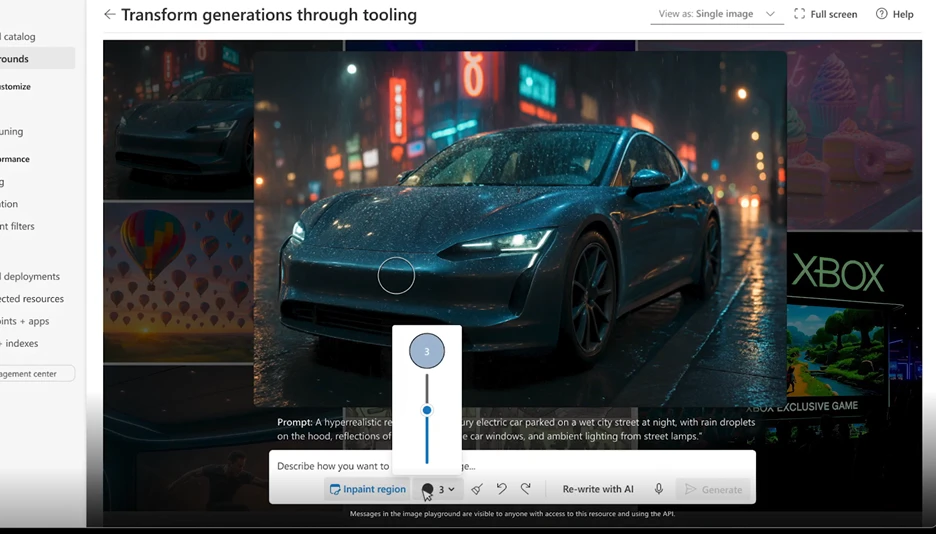
  • Inpainting: Editen imágenes con prompts de texto y cuadros delimitadores dibujados por el usuario, de forma similar a inpainting con DALL-E.
Grupo de imágenes de personas en una habitación

Casos de uso

GPT-image-1 está diseñado para impulsar una amplia gama de aplicaciones, entre ellas:

  • Generación de material educativo: Crear ayudas visuales y contenidos interactivos para el aprendizaje.
  • Creación de libros de cuentos: Generación de ilustraciones consistentes y atractivas para libros infantiles.
  • Producción de juegos: Desarrollar activos de juego con un estilo y un diseño de personajes coherentes.
  • Diseños de interfaz de usuario: Diseñar interfaces de usuario con elementos fotorrealistas y diseños coherentes.
Captura de pantalla de una computadora

Especificaciones técnicas

  • Resolución: admite imágenes con una anchura y una altura mínimas de 1024 píxeles, incluidas las resoluciones 1024×1024, 1024×1536 y 1536×1024.
  • Integración de API: Gpt-image-1 está disponible a través de API.

Seguridad y moderación

GPT-image-1 está construido con una sólida pila de seguridad de OpenAI, que incluye c2pa y moderación de entrada/salida. Los elementos específicos de Azure AI incluyen: Seguridad del contenido y supervisión de abusos.

Comiencen hoy mismo

Den rienda suelta a su potencial creativo con GPT-image-1, la tecnología de vanguardia diseñada para elevar sus proyectos artísticos. Con capacidades que admiten imágenes de alta resolución y una integración perfecta de API, pueden dar vida a sus visiones sin esfuerzo. Experimenten los impresionantes elementos fotorrealistas y los diseños coherentes que diferenciarán sus proyectos. Utilicen la generación de imágenes ética y segura con los sólidos sistemas de moderación de GPT-image-1, lo que la convierte en la opción clara para todas sus necesidades creativas.

Descubran hoy mismo el poder transformador de GPT-image-1.

The post Presentamos GPT-image-1: Alcanzar nuevas alturas con la generación de imágenes en Azure AI Foundry appeared first on Source LATAM.


​The post Presentamos GPT-image-1: Alcanzar nuevas alturas con la generación de imágenes en Azure AI Foundry appeared first on Source LATAM.  

Publicado el Deja un comentario

Amazon CloudWatch Application Signals introduces auto-monitor support for EKS workloads

CloudWatch Application Signals, an application performance monitoring (APM) tool that simplifies health and performance monitoring for applications, now makes instrumentation easier for your EKS applications through a single configuration flag within the Amazon CloudWatch Observability add-on. Once enabled, you can gain access to pre-built, standardized dashboards within CloudWatch Application Signals and track application performance against key business or service-level objectives (SLOs), making it easier to troubleshoot issues for your EKS applications.

SRE teams can now setup APM on CloudWatch on EKS by simply installing and configuring the Amazon CloudWatch EKS add-on, eliminating the need for manual coordination between teams and enabling rapid setup in just a few minutes. Once the add-on is installed and the flag is enabled, the add-on automatically discovers applications along with their dependencies. The add-on then instruments these applications with AWS Distro for OpenTelemetry SDKs (ADOT) to collect application metrics (throughput, latency, and errors), distributed traces and logs after the restarts.

To get started, install or upgrade the Amazon CloudWatch EKS add-on to version v4.0.0-eksbuild.1 and enable Application Signals monitoring via the new configuration flag. All service workload applications deployed in EKS are monitored by default, but you can customize the configuration to focus on specific services that matter most to your business. See documentation to learn more.

This enhancement is now available in all commercial AWS Regions where both EKS and CloudWatch Application Signals are supported. You can now opt in to the new bundled pricing for Application Signals. For pricing, see Amazon CloudWatch pricing.


​CloudWatch Application Signals, an application performance monitoring (APM) tool that simplifies health and performance monitoring for applications, now makes instrumentation easier for your EKS applications through a single configuration flag within the Amazon CloudWatch Observability add-on. Once enabled, you can gain access to pre-built, standardized dashboards within CloudWatch Application Signals and track application performance against key business or service-level objectives (SLOs), making it easier to troubleshoot issues for your EKS applications. SRE teams can now setup APM on CloudWatch on EKS by simply installing and configuring the Amazon CloudWatch EKS add-on, eliminating the need for manual coordination between teams and enabling rapid setup in just a few minutes. Once the add-on is installed and the flag is enabled, the add-on automatically discovers applications along with their dependencies. The add-on then instruments these applications with AWS Distro for OpenTelemetry SDKs (ADOT) to collect application metrics (throughput, latency, and errors), distributed traces and logs after the restarts. To get started, install or upgrade the Amazon CloudWatch EKS add-on to version v4.0.0-eksbuild.1 and enable Application Signals monitoring via the new configuration flag. All service workload applications deployed in EKS are monitored by default, but you can customize the configuration to focus on specific services that matter most to your business. See documentation to learn more. This enhancement is now available in all commercial AWS Regions where both EKS and CloudWatch Application Signals are supported. You can now opt in to the new bundled pricing for Application Signals. For pricing, see Amazon CloudWatch pricing.    

Publicado el Deja un comentario

The next generation of Amazon SageMaker is now available in an additional region

The next generation of Amazon SageMaker is now available in AWS Europe (Stockholm).

Amazon SageMaker is the center for all your data, analytics, and AI. From SageMaker Unified Studio, you can discover your data and put it to work using familiar AWS tools for model development, generative AI app development, data processing, and SQL analytics. Unified access to data is provided by Amazon SageMaker Lakehouse, and catalog and governance features are available via SageMaker Catalog (built on Amazon DataZone) to help you meet enterprise security requirements.

For more information on AWS Regions where the next generation of Amazon SageMaker is available, see Supported regions.

To get started, see the following resources:


​The next generation of Amazon SageMaker is now available in AWS Europe (Stockholm). Amazon SageMaker is the center for all your data, analytics, and AI. From SageMaker Unified Studio, you can discover your data and put it to work using familiar AWS tools for model development, generative AI app development, data processing, and SQL analytics. Unified access to data is provided by Amazon SageMaker Lakehouse, and catalog and governance features are available via SageMaker Catalog (built on Amazon DataZone) to help you meet enterprise security requirements. For more information on AWS Regions where the next generation of Amazon SageMaker is available, see Supported regions.
To get started, see the following resources:

SageMaker overview
SageMaker documentation  

Publicado el Deja un comentario

Amazon RDS for MariaDB now supports community MariaDB minor versions 10.5.29 and 10.6.22

Amazon Relational Database Service (Amazon RDS) for MariaDB now supports community MariaDB minor versions 10.5.29 and 10.6.22. We recommend that you upgrade to the latest minor versions to fix known security vulnerabilities in prior versions of MariaDB, and to benefit from the bug fixes, performance improvements, and new functionality added by the MariaDB community.

You can leverage automatic minor version upgrades to automatically upgrade your databases to more recent minor versions during scheduled maintenance windows. You can also leverage Amazon RDS Managed Blue/Green deployments for safer, simpler, and faster updates to your MariaDB instances. Learn more about upgrading your database instances, including automatic minor version upgrades and Blue/Green Deployments, in the Amazon RDS User Guide.

Amazon RDS for MariaDB makes it straightforward to set up, operate, and scale MariaDB deployments in the cloud. Learn more about pricing details and regional availability at Amazon RDS for MariaDB. Create or update a fully managed Amazon RDS database in the Amazon RDS Management Console.


​Amazon Relational Database Service (Amazon RDS) for MariaDB now supports community MariaDB minor versions 10.5.29 and 10.6.22. We recommend that you upgrade to the latest minor versions to fix known security vulnerabilities in prior versions of MariaDB, and to benefit from the bug fixes, performance improvements, and new functionality added by the MariaDB community. You can leverage automatic minor version upgrades to automatically upgrade your databases to more recent minor versions during scheduled maintenance windows. You can also leverage Amazon RDS Managed Blue/Green deployments for safer, simpler, and faster updates to your MariaDB instances. Learn more about upgrading your database instances, including automatic minor version upgrades and Blue/Green Deployments, in the Amazon RDS User Guide. Amazon RDS for MariaDB makes it straightforward to set up, operate, and scale MariaDB deployments in the cloud. Learn more about pricing details and regional availability at Amazon RDS for MariaDB. Create or update a fully managed Amazon RDS database in the Amazon RDS Management Console.