Publicado el Deja un comentario

Amazon Rekognition Face Liveness launches accuracy improvements and new challenge setting for improved UX

Today, AWS announces accuracy improvements and new settings for Amazon Rekognition Face Liveness. Amazon Rekognition Face Liveness is a feature of Amazon Rekognition that detects in real-time whether real users, not bad actors using spoofs, can access your services.

Customers across financial, gig economy, telecommunications, healthcare, and social media use Rekognition Face Liveness detection for workflows such as onboarding, authentication, and bot detection. Until now, Rekognition Liveness only offered a single experience with the ‘FaceMovementAndLightChallenge’ setting, which delivers the highest accuracy by requiring users to move their face toward the screen and hold still for a series of flashing lights. With this launch, the new ‘FaceMovementChallenge’ setting reduces the check time by 3 seconds by eliminating the flashing lights. While ‘FaceMovementAndLightChallenge’ remains the best setting to maximize accuracy, ‘FaceMovementChallenge’ allows customers to prioritize faster liveness checks when appropriate. For additional flexibility, ‘FaceMovementChallenge’, allows users to complete checks using the front or back facing camera. Lastly, this update also delivers improved accuracy across both settings to aid with fraud mitigation.

The new Face Liveness settings are available in all AWS commercial regions where Rekognition Liveness is offered at no additional cost. Customers can enable the ‘FaceMovementChallenge’ setting in the CreateFaceLivenessSession API call.

To get started with the new settings, visit the Amazon Rekognition Face Liveness page or refer to the Amazon Rekognition Developer Guide.


​Today, AWS announces accuracy improvements and new settings for Amazon Rekognition Face Liveness. Amazon Rekognition Face Liveness is a feature of Amazon Rekognition that detects in real-time whether real users, not bad actors using spoofs, can access your services. Customers across financial, gig economy, telecommunications, healthcare, and social media use Rekognition Face Liveness detection for workflows such as onboarding, authentication, and bot detection. Until now, Rekognition Liveness only offered a single experience with the ‘FaceMovementAndLightChallenge’ setting, which delivers the highest accuracy by requiring users to move their face toward the screen and hold still for a series of flashing lights. With this launch, the new ‘FaceMovementChallenge’ setting reduces the check time by 3 seconds by eliminating the flashing lights. While ‘FaceMovementAndLightChallenge’ remains the best setting to maximize accuracy, ‘FaceMovementChallenge’ allows customers to prioritize faster liveness checks when appropriate. For additional flexibility, ‘FaceMovementChallenge’, allows users to complete checks using the front or back facing camera. Lastly, this update also delivers improved accuracy across both settings to aid with fraud mitigation. The new Face Liveness settings are available in all AWS commercial regions where Rekognition Liveness is offered at no additional cost. Customers can enable the ‘FaceMovementChallenge’ setting in the CreateFaceLivenessSession API call. To get started with the new settings, visit the Amazon Rekognition Face Liveness page or refer to the Amazon Rekognition Developer Guide.  

Publicado el Deja un comentario

Amazon Connect launches additional APIs to update and delete cases and related case items

Amazon Connect now provides APIs that allow you to delete cases, case comments, undo contact associations, and remove service level agreements (SLAs) from cases. These new capabilities enable you to programmatically remove sensitive customer information from cases or delete cases upon a customer’s request.

Amazon Connect Cases is available in the following AWS regions: US East (N. Virginia), US West (Oregon), Canada (Central), Europe (Frankfurt), Europe (London), Asia Pacific (Seoul), Asia Pacific (Singapore), Asia Pacific (Sydney), and Asia Pacific (Tokyo) AWS regions. To learn more and get started, visit the Amazon Connect Cases webpage and documentation.


​Amazon Connect now provides APIs that allow you to delete cases, case comments, undo contact associations, and remove service level agreements (SLAs) from cases. These new capabilities enable you to programmatically remove sensitive customer information from cases or delete cases upon a customer’s request. Amazon Connect Cases is available in the following AWS regions: US East (N. Virginia), US West (Oregon), Canada (Central), Europe (Frankfurt), Europe (London), Asia Pacific (Seoul), Asia Pacific (Singapore), Asia Pacific (Sydney), and Asia Pacific (Tokyo) AWS regions. To learn more and get started, visit the Amazon Connect Cases webpage and documentation.    

Publicado el Deja un comentario

Amazon Connect now provides enhanced flow designer UI editing features

Amazon Connect now provides new editing and accessibility enhancements for the drag-and-drop flow designer making it easier to build customer service experiences. These enhancements include keyboard navigation, auto arranging of blocks, screen reader support, and improved support for high zoom on browsers. Additionally, when editing a flow block in configuration side panel on the flow designer UI, you can view and edit all incoming and outgoing branch connections, create new flow blocks, and review all attached notes. Each of these capabilities can be accessed through new keyboard shortcuts which are visible on the canvas.

To learn more, see the Amazon Connect Administrator Guide. These features are available in all AWS regions where Amazon Connect is available. To learn more about Amazon Connect, the AWS contact center as a service solution on the cloud, please visit the Amazon Connect website.


​Amazon Connect now provides new editing and accessibility enhancements for the drag-and-drop flow designer making it easier to build customer service experiences. These enhancements include keyboard navigation, auto arranging of blocks, screen reader support, and improved support for high zoom on browsers. Additionally, when editing a flow block in configuration side panel on the flow designer UI, you can view and edit all incoming and outgoing branch connections, create new flow blocks, and review all attached notes. Each of these capabilities can be accessed through new keyboard shortcuts which are visible on the canvas. To learn more, see the Amazon Connect Administrator Guide. These features are available in all AWS regions where Amazon Connect is available. To learn more about Amazon Connect, the AWS contact center as a service solution on the cloud, please visit the Amazon Connect website.  

Publicado el Deja un comentario

Amazon Aurora DSQL is now available in additional AWS Regions

Amazon Aurora DSQL is now available in Asia Pacific (Seoul) and supports multi-Region clusters within Asia Pacific Regions – Asia Pacific (Osaka), Asia Pacific (Tokyo), Asia Pacific (Seoul) as well as European Regions – Europe (Ireland), Europe (London), Europe (Paris). Aurora DSQL is the fastest serverless, distributed SQL database with active-active high availability and multi-Region strong consistency. Aurora DSQL enables you to build always available applications with virtually unlimited scalability, the highest availability, and zero infrastructure management. It is designed to make scaling and resilience effortless for your applications and offers the fastest distributed SQL reads and writes.

Aurora DSQL is available in the following AWS Regions: US East (N. Virginia), US East (Ohio), US West (Oregon), Asia Pacific (Osaka), Asia Pacific (Tokyo), Asia Pacific (Seoul), Europe (Ireland), Europe (London), and Europe (Paris).

Get started with Aurora DSQL for free with the AWS Free Tier. To learn more, visit the Aurora DSQL webpage and documentation.


​Amazon Aurora DSQL is now available in Asia Pacific (Seoul) and supports multi-Region clusters within Asia Pacific Regions – Asia Pacific (Osaka), Asia Pacific (Tokyo), Asia Pacific (Seoul) as well as European Regions – Europe (Ireland), Europe (London), Europe (Paris). Aurora DSQL is the fastest serverless, distributed SQL database with active-active high availability and multi-Region strong consistency. Aurora DSQL enables you to build always available applications with virtually unlimited scalability, the highest availability, and zero infrastructure management. It is designed to make scaling and resilience effortless for your applications and offers the fastest distributed SQL reads and writes. Aurora DSQL is available in the following AWS Regions: US East (N. Virginia), US East (Ohio), US West (Oregon), Asia Pacific (Osaka), Asia Pacific (Tokyo), Asia Pacific (Seoul), Europe (Ireland), Europe (London), and Europe (Paris). Get started with Aurora DSQL for free with the AWS Free Tier. To learn more, visit the Aurora DSQL webpage and documentation.  

Publicado el Deja un comentario

Amazon Aurora PostgreSQL database clusters now support up to 256 TiB of storage volume

Amazon Aurora PostgreSQL-Compatible Edition now supports a maximum storage limit of 256 TiB, doubling the previous limit of 128 TiB. This enhancement allows customers to store and manage even larger datasets within a single Aurora database cluster simplifying data management for large-scale applications and supporting the growing data needs of modern applications. Customers only pay for the storage they use, with no need for upfront provisioning of the full 256 TiB.

To access the increased storage limit, upgrade your cluster to supported database versions. Once upgraded, Aurora storage will automatically scale up to 256 TiB capacity based on the amount of data in the cluster volume. Visit technical documentation to learn more about supported versions. This new storage volume capacity is available in all AWS regions where Aurora PostgreSQL is available.

Amazon Aurora is designed for unparalleled high performance and availability at global scale with full MySQL and PostgreSQL compatibility. It provides built-in security, continuous backups, serverless compute, up to 15 read replicas, automated multi-Region replication, and integrations with other AWS services. To get started with Amazon Aurora, take a look at our getting started page.


​Amazon Aurora PostgreSQL-Compatible Edition now supports a maximum storage limit of 256 TiB, doubling the previous limit of 128 TiB. This enhancement allows customers to store and manage even larger datasets within a single Aurora database cluster simplifying data management for large-scale applications and supporting the growing data needs of modern applications. Customers only pay for the storage they use, with no need for upfront provisioning of the full 256 TiB. To access the increased storage limit, upgrade your cluster to supported database versions. Once upgraded, Aurora storage will automatically scale up to 256 TiB capacity based on the amount of data in the cluster volume. Visit technical documentation to learn more about supported versions. This new storage volume capacity is available in all AWS regions where Aurora PostgreSQL is available. Amazon Aurora is designed for unparalleled high performance and availability at global scale with full MySQL and PostgreSQL compatibility. It provides built-in security, continuous backups, serverless compute, up to 15 read replicas, automated multi-Region replication, and integrations with other AWS services. To get started with Amazon Aurora, take a look at our getting started page.  

Publicado el Deja un comentario

Robótica para la protección y mitigación de incendios forestales

julio 3, 2025

Robótica para la protección y mitigación de incendios forestales

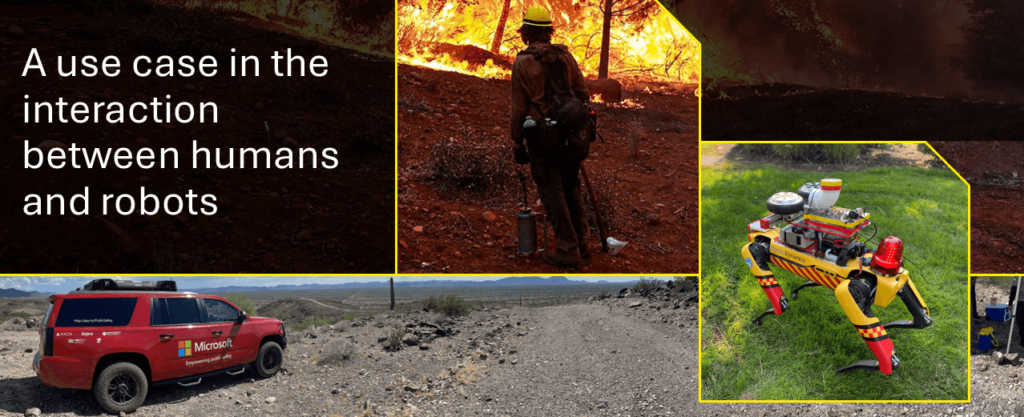
Un caso de uso en la interacción entre humanos y robots

Bombero combatiendo un incendio forestal con una superposición de robot

Un pilar fundamental de la estrategia que construimos es la forma en que los humanos, los robots y los agentes de IA se unen. Este proyecto fue un catalizador para eso.

– Dan Rosenstein

Acerca de la robótica para la protección y mitigación de incendios forestales

El verano de 2022 en Estados Unidos estuvo marcado por implacables incendios forestales, que quemaron millones de hectáreas y devastaron comunidades. Según el Centro Nacional Interagencial de Incendios, 66,255 incendios quemaron la asombrosa cantidad de 7,534,403 acres. La temporada de incendios forestales se había alargado debido a primaveras más cálidas, períodos secos de verano prolongados y suelos cada vez más áridos. En medio de este caos, un equipo de innovadores apasionados que trabajan con The Garage desarrollaron una solución innovadora: robótica para la protección y mitigación de incendios forestales.

La idea surgió durante el Microsoft Global Hackathon 2022, cuando el incendio Mosquito arrasó California, en el que fueron devastadas 76,788 acres y tuvo una duración de casi dos meses. Los incendios forestales afectan innumerables vidas y causan trágicas pérdidas entre los bomberos. Durante este tiempo, Lou Amadio, un arquitecto principal que vivía en el estado de Washington, sintió una urgencia personal. «Mi casa está en una zona propensa a los incendios forestales. Cada año observamos con impotencia cómo surgen incendios y son combatidos con valentía por los bomberos de todo el estado», dice Lou, quien propuso el plan Wildfire Robotics Hackathon. «¿Podrían los robots ayudar con la detección temprana o mantener a los bomberos seguros mientras luchan contra los incendios forestales?» Inspirado por la urgente necesidad de una protección avanzada contra los incendios forestales, el equipo del proyecto se embarcó en esta ambiciosa iniciativa.

Esa decisión puso en marcha una serie de fichas de dominó, que al final se ramificaron en dos resultados: uno que exploró la interacción humano-robot y otro que avanzó en la comprensión del estado de la protección y mitigación de incendios forestales de maneras imprevistas.

A través de incesantes iteraciones y pivotes, el equipo logró notables avances técnicos. «Queríamos probar varias hipótesis en torno a los robots que ayudan a combatir incendios al mantener a los bomberos a una distancia segura de las llamas y los productos químicos que pueden ser dañinos», explicó Dan Rosenstein, gerente del programa del grupo principal.

Transportar agua planteó un desafío obvio para la robótica, por lo que el equipo se inspiró en las «bolas de extintor de incendios», dispositivos pirotécnicos que dispersan un supresor químico seco llamado fosfato monoamónico. Este compuesto no solo extingue incendios, sino que actúa como fertilizante para ayudar a la recuperación de los bosques.

A partir de ahí, el equipo exploró cómo integrar los robots en el software de mando y control, que se utiliza cada vez más para coordinar la respuesta a los incendios forestales. «TAK, el software Team Awareness Kit introducido por el gobierno de los Estados Unidos y los contratistas, ha comenzado a ser adoptado de manera amplia por las agencias de respuesta a desastres. Desarrollamos un adaptador de software que permite a los robots informar de sus posiciones y recibir planes de ruta de los líderes del equipo», dijo Lou.

El proyecto ha puesto de relieve las oportunidades para realizar mejoras significativas en los esfuerzos de protección contra los incendios forestales. Durante el Hackathon, el equipo se puso en contacto con el personal de respuesta a emergencias de Microsoft, que apoya a los socorristas de todo el mundo. Aprendieron que la fase de «limpieza», que ocurre poco después de que se extinguen las llamas, presenta serios riesgos para los bomberos debido al alto potencial de llamaradas. Los robots pueden ser en especial valiosos durante esta fase. Muchos valientes bomberos han perdido la vida a causa de este tipo de brotes. «Si podemos desplegar robots y drones para buscar ‘puntos calientes’, pueden compartir marcadores geolocalizados para lanzamientos aéreos o supresión desde lejos. Enfrentamos numerosos desafíos, pero nuestra determinación y espíritu de colaboración nos mantuvieron en marcha», enfatizó Dan.

Microsoft Garage proporcionó un entorno en el que prosperaron la creatividad y la innovación. Dan sonrió: «El Hackathon es para todos nosotros. Hay aprendizaje, hay un desafío comercial, hay una oportunidad, hay una oportunidad de repasar las habilidades de codificación, y esto germina el deseo de volver a hacer Hackathon». Ed Essey, el entrenador en jefe de The Garage que ayudó al equipo a avanzar en su proyecto, compartió: «Este es un proyecto importante que ayuda a salvar vidas. También revela cómo la innovación en las primeras etapas puede revelar oportunidades inesperadas».

Algunas de esas oportunidades inesperadas fueron como fichas de dominó que el equipo ni siquiera había visto al principio. A medida que la primera idea avanzaba, se desencadenaron dos senderos distintos: uno que iluminó los desafíos sistémicos en la respuesta a los incendios forestales y otro que abrió nuevas posibilidades para la colaboración entre humanos y robots.

El primer rastro de fichas de dominó reveló oportunidades fundamentales en la lucha contra los incendios forestales. Antes de que la robótica pueda ser en verdad eficaz, el ecosistema debe someterse a una transformación digital, desde mapas impresos hasta herramientas digitales. Esta constatación desencadenó esfuerzos de modernización, lo que sentó las bases para operaciones más eficientes y la futura integración de tecnología. También expuso barreras críticas: presupuestos limitados y la necesidad de adoptar nuevas tecnologías por fases. Con la escasez de fondos, la robótica todavía está fuera del alcance de muchos, lo que ha provocado un giro hacia soluciones rentables y la defensa de una mayor inversión. Mientras tanto, las prácticas tradicionales son todavía muy extendidas, por lo que la formación y la educación son esenciales para generar confianza en las herramientas digitales y allanar el camino para una adopción más amplia.

Esa comprensión desencadenó un segundo rastro de fichas de dominó, esta vez que condujo a la colaboración avanzada entre humanos y robots. Si bien algunos casos de uso todavía son confidenciales, ya se han hecho públicos varios hitos. El Hackathon condujo al desarrollo de una interfaz basada en Teams para la interacción humano-robot-IA, que permite el control remoto de robots durante una llamada. Este avance demostró el potencial para expandirse a la formación de equipos humano-robot-IA y alinearse con la visión estratégica más amplia de Microsoft. El trabajo generó nuevas iniciativas, influyó en la dirección de la empresa y generó una ola de innovación, consolidando el impacto del proyecto en el valor comercial.

En la actualidad, el proyecto sigue con su evolución dentro de Microsoft, al avanzar con nuevos objetivos e iniciativas, y realizar cambios positivos en la protección y mitigación de incendios forestales.

Este proyecto innovador ejemplifica el énfasis de The Garage en fomentar la creatividad y la resolución de problemas para lograr un impacto significativo.

The post Robótica para la protección y mitigación de incendios forestales appeared first on Source LATAM.


​The post Robótica para la protección y mitigación de incendios forestales appeared first on Source LATAM.  

Publicado el Deja un comentario

Amazon S3 Express One Zone now supports tags for cost allocation and attribute-based access control

Amazon S3 Express One Zone, a high performance S3 storage class, now supports tags for cost allocation and attribute-based access control (ABAC). You can add tags to S3 directory buckets to track and organize AWS costs using AWS Billing and Cost Management. Additionally, with ABAC support, you can extend your tag-based access control to new and existing users, roles, and directory buckets. This helps eliminate frequent AWS Identity and Access Management (IAM) or S3 bucket policy updates, simplifying how you scale access governance.

S3 Express One Zone supports tags on directory buckets in all AWS Regions where the storage class is available. You can get started with tagging using the AWS Management Console, S3 REST API, AWS CLI, or the AWS SDK. To learn more about using tags to simplify cost allocation or ABAC, visit the S3 User Guide.


​Amazon S3 Express One Zone, a high performance S3 storage class, now supports tags for cost allocation and attribute-based access control (ABAC). You can add tags to S3 directory buckets to track and organize AWS costs using AWS Billing and Cost Management. Additionally, with ABAC support, you can extend your tag-based access control to new and existing users, roles, and directory buckets. This helps eliminate frequent AWS Identity and Access Management (IAM) or S3 bucket policy updates, simplifying how you scale access governance. S3 Express One Zone supports tags on directory buckets in all AWS Regions where the storage class is available. You can get started with tagging using the AWS Management Console, S3 REST API, AWS CLI, or the AWS SDK. To learn more about using tags to simplify cost allocation or ABAC, visit the S3 User Guide.  

Publicado el Deja un comentario

AWS Site-to-Site VPN extends AWS Secrets Manager integration in additional AWS Regions

AWS Site-to-Site VPN is extending three new capabilities, including AWS Secrets Manager integration, for enhanced security and ease of configuration in AWS GovCloud (US) Regions and AWS Europe (Milan) Region.

  • AWS Secrets Manager Integration: With the AWS Secrets Manager integration, when customers store their pre-shared keys (PSKs) in Secrets Manager, VPN connection API responses will redact the PSK and instead display the Secrets Manager ARN (Amazon Resource Name), providing enhanced security.
  • New API to track VPN algorithms: You can now easily track the currently negotiated internet key exchange (IKE) version, Diffie-Hellman (DH) groups, encryption algorithms, and integrity algorithms using the “GetActiveVpnTunnelStatus” API. This new API eliminates the need for you to enable Site-to-Site VPN logs to get this information, saving time and reducing operational overhead.
  • Recommended Configuration: “GetVpnConnectionDeviceSampleConfiguration” API now includes “recommended” parameter to help you use the best-practices security configuration – IKE version 2, DH group 20, SHA-384 integrity algorithm, and AES-GCM-256 encryption algorithm – on your customer gateway devices, reducing configuration time and potential errors.

There is no additional charge for using these capabilities. To learn more and get started, visit the AWS Site-to-Site VPN documentation.


​AWS Site-to-Site VPN is extending three new capabilities, including AWS Secrets Manager integration, for enhanced security and ease of configuration in AWS GovCloud (US) Regions and AWS Europe (Milan) Region.

AWS Secrets Manager Integration: With the AWS Secrets Manager integration, when customers store their pre-shared keys (PSKs) in Secrets Manager, VPN connection API responses will redact the PSK and instead display the Secrets Manager ARN (Amazon Resource Name), providing enhanced security.
New API to track VPN algorithms: You can now easily track the currently negotiated internet key exchange (IKE) version, Diffie-Hellman (DH) groups, encryption algorithms, and integrity algorithms using the “GetActiveVpnTunnelStatus” API. This new API eliminates the need for you to enable Site-to-Site VPN logs to get this information, saving time and reducing operational overhead.
Recommended Configuration: “GetVpnConnectionDeviceSampleConfiguration” API now includes “recommended” parameter to help you use the best-practices security configuration – IKE version 2, DH group 20, SHA-384 integrity algorithm, and AES-GCM-256 encryption algorithm – on your customer gateway devices, reducing configuration time and potential errors.

There is no additional charge for using these capabilities. To learn more and get started, visit the AWS Site-to-Site VPN documentation.  

Publicado el Deja un comentario

New features for AWS Neuron 2.24 include PyTorch 2.7 and inference enhancements

Today, AWS announces the general availability of Neuron 2.24, delivering new features and performance improvements for customers building and deploying deep learning models on AWS Inferentia and Trainium-based instances. Neuron 2.24 introduces support for PyTorch 2.7, enhanced inference capabilities, and expanded compatibility with popular machine learning frameworks. These updates help developers and data scientists accelerate model training and inference, improve efficiency, and simplify the deployment of large language models and other AI workloads.

With Neuron 2.24, customers can take advantage of advanced inference features such as prefix caching for faster Time-To-First-Token (TTFT), disaggregated inference to reduce prefill-decode interference, and context parallelism for improved performance on long sequences. The release also brings support for Qwen 2.5 text models and improved integration with Hugging Face Optimum Neuron and PyTorch-based NxD Core backend.

Neuron 2.24 is available in all AWS Regions where Inferentia and Trainium instances are offered.

To learn more and for a full list of new features and enhancements, see:


​Today, AWS announces the general availability of Neuron 2.24, delivering new features and performance improvements for customers building and deploying deep learning models on AWS Inferentia and Trainium-based instances. Neuron 2.24 introduces support for PyTorch 2.7, enhanced inference capabilities, and expanded compatibility with popular machine learning frameworks. These updates help developers and data scientists accelerate model training and inference, improve efficiency, and simplify the deployment of large language models and other AI workloads. With Neuron 2.24, customers can take advantage of advanced inference features such as prefix caching for faster Time-To-First-Token (TTFT), disaggregated inference to reduce prefill-decode interference, and context parallelism for improved performance on long sequences. The release also brings support for Qwen 2.5 text models and improved integration with Hugging Face Optimum Neuron and PyTorch-based NxD Core backend. Neuron 2.24 is available in all AWS Regions where Inferentia and Trainium instances are offered. To learn more and for a full list of new features and enhancements, see:

AWS Neuron 2.24 release notes
Trn2 Instances
Trn1 Instances
Inf2 Instances  

Publicado el Deja un comentario

Amazon Q Business launches the ability to customize responses

Amazon Q Business, the generative AI-powered assistant for finding information, gaining insight, and taking action at work, today introduced response customization for Q Business applications. This new capability enables organizations to tailor how their Q Business applications generate and format responses to user queries, ensuring consistent communication for all users.

With response customization, customers can provide instructions for identity, tone, and output style when configuring Q Business applications. This customizes the chat persona and its communication formality, along with response length and detail to match their specific needs. This feature includes built-in guardrails to ensure that response settings align with existing admin controls.

Response customization is available in all AWS Regions where Amazon Q Business is offered. To learn more about this feature, visit the Amazon Q Business User Guide and Amazon Q Business API Reference documentation.


​Amazon Q Business, the generative AI-powered assistant for finding information, gaining insight, and taking action at work, today introduced response customization for Q Business applications. This new capability enables organizations to tailor how their Q Business applications generate and format responses to user queries, ensuring consistent communication for all users. With response customization, customers can provide instructions for identity, tone, and output style when configuring Q Business applications. This customizes the chat persona and its communication formality, along with response length and detail to match their specific needs. This feature includes built-in guardrails to ensure that response settings align with existing admin controls. Response customization is available in all AWS Regions where Amazon Q Business is offered. To learn more about this feature, visit the Amazon Q Business User Guide and Amazon Q Business API Reference documentation.