
Publicado el Deja un comentario

Sostenible por diseño: Innovar para cero residuos

abril 24, 2025

Sostenible por diseño: Innovar para cero residuos

Imagen decorativa de una espiral abstracta con elementos verdes, azules y morados

Por: Rani Borkar, vicepresidenta corporativa de sistemas de hardware e infraestructura de Azure.

Anunciamos la consecución de un hito importante en nuestro camino hacia cero residuos en 2030: hemos alcanzado una tasa de reutilización y reciclaje de servidores y componentes del 90,9% en 2024, lo que supera nuestro objetivo para 2025 del 90% anual antes de lo previsto.

Cero residuos para 2030 es una piedra angular de nuestra estrategia de sostenibilidad, junto con convertirnos en carbono negativo, agua positiva y proteger más tierra de la que utilizamos. Este hito reciente, impulsado por una cultura de innovación y colaboración interfuncional, refleja el creciente impulso para integrar prácticas de cero residuos y circularidad en toda la industria tecnológica.

Con el trabajo en conjunto con nuestros socios y proveedores de recuperación, avanzamos en la sostenibilidad de nuestra cadena de suministro en la nube y avanzamos hacia nuestro objetivo de cero residuos en tres áreas clave: (1) pilotar la extracción sostenible de minerales de tierras raras de unidades de disco duro a escala, (2) continuar la expansión de nuestros Centros Circulares en todo el mundo y (3) creación en conjunto de soluciones de embalaje reciclables para el transporte de hardware de centros de datos.
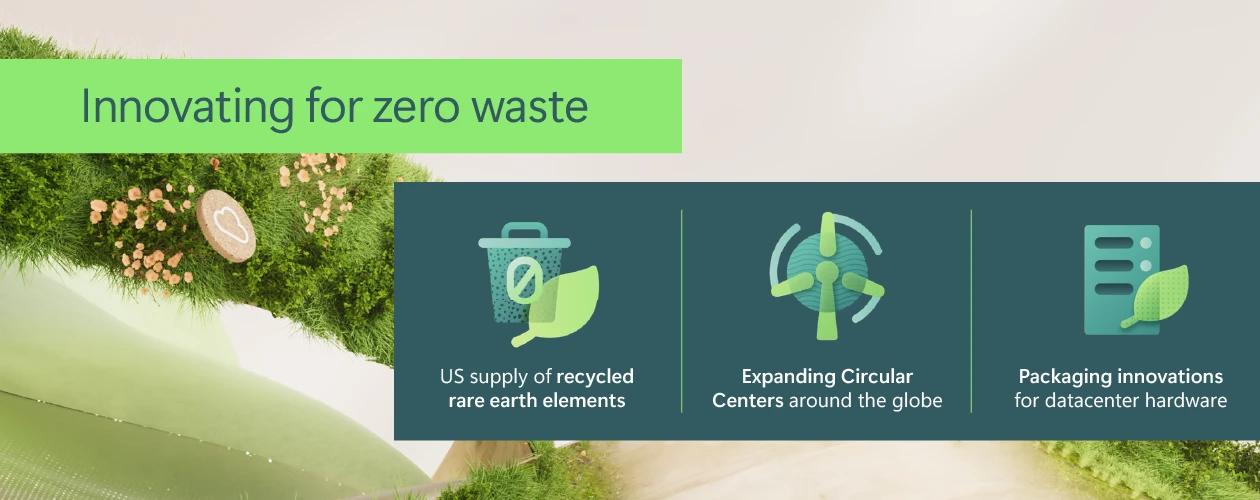
Una planta verde con un letrero y dentro de este otra planta verde

Innovar para crear un suministro de elementos de tierras raras reciclados con sede en EE. UU.

Hoy anunciamos una colaboración con Western Digital, Critical Materials Recycling y PedalPoint Recycling que demuestra cómo transformamos aproximadamente 50 mil libras de unidades de disco duro (HDD, por sus siglas en inglés) al final de su vida útil y otros materiales en materiales críticos de alto valor, para recuperar elementos de tierras raras (REE, por sus siglas en inglés) como el neodimio y metales preciosos como el oro y el cobre. Al permitir que el proceso de recuperación de REE se gestione a nivel nacional, el programa se diseñó para minimizar las emisiones del transporte y aumentar la resiliencia de la cadena de suministro de REE de los Estados Unidos al disminuir la dependencia de los materiales importados.

Cuando los discos duros se retiran del servicio, los componentes portadores de datos se desinfectan y trituran para garantizar la seguridad de los datos, mientras que otros componentes se separan para permitir el reciclaje y la recirculación de los materiales REE. Esta iniciativa abordó algunos de los desafíos técnicos persistentes con el reciclaje de REE: desarrollar métodos para lograr una alta tasa de recuperación de los materiales, encontrar una técnica de reciclaje que evite el uso de productos químicos agresivos y demostrar que el proceso de reciclaje de REE puede ser viable a nivel económico a largo plazo.

La innovadora disolución sin ácido de los discos duros triturados proporcionó una impresionante recuperación de alto rendimiento del 90% de materiales elementales y de tierras raras. Además, el proceso de reciclaje tiene una reducción estimada del 95% en las emisiones en comparación con las prácticas tradicionales de minería y procesamiento, según el análisis del ciclo de vida. Esta iniciativa, que estableció un nuevo estándar para la recuperación industrial de materiales críticos, fue una de las primeras demostraciones del reciclaje a gran escala en el país de metales y materiales esenciales.

Expansión de los Centros Circulares en todo el mundo

En toda la empresa, nuestros equipos trabajan para mejorar la eficiencia de los recursos y ampliar el valor de la vida útil de los materiales a través de las tres R: reducir, reutilizar y recuperar. Dentro de nuestros centros de datos globales, nuestros Centros Circulares de Microsoft son fundamentales para nuestro progreso, ya que nos permiten procesar y enrutar servidores y componentes de hardware fuera de servicio a sus próximas vidas útiles, como la reutilización interna, otras cadenas de suministro electrónico o academias que capacitan a los técnicos de los centros de datos.
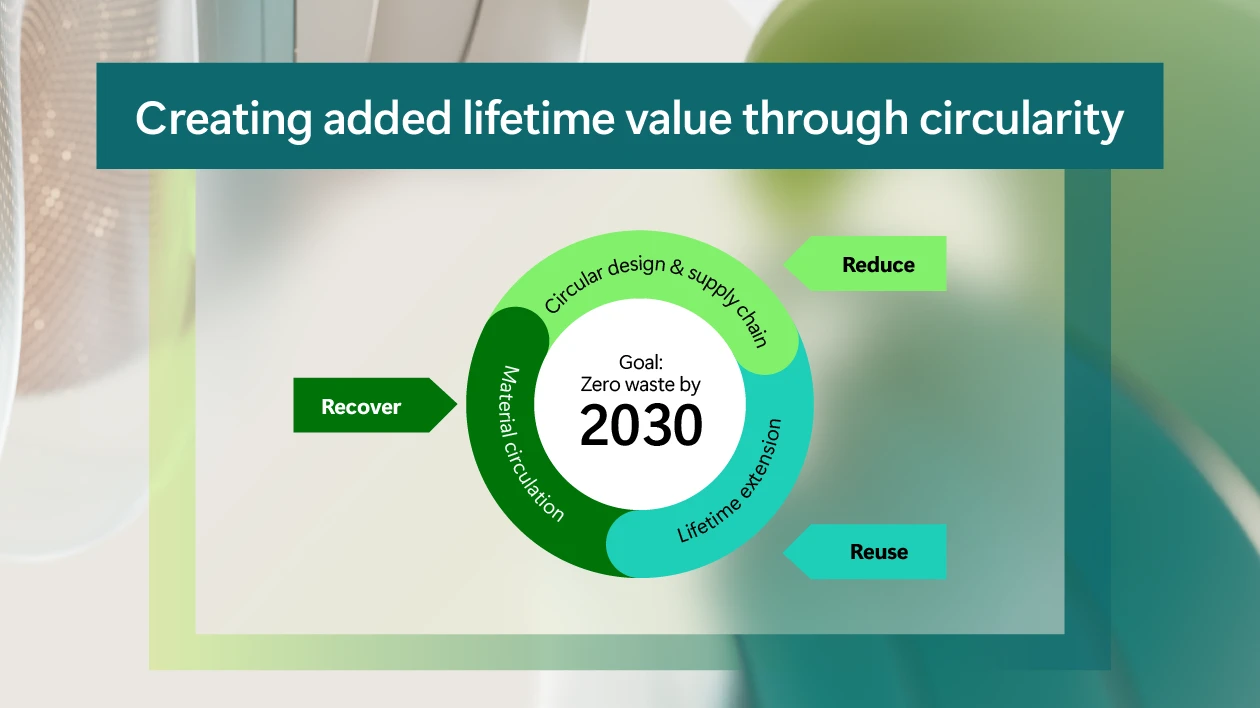
Captura de pantalla de un diagrama

Al rediseñar los sistemas para reducir los residuos, y luego reutilizar y recuperar materiales siempre que sea posible, ahorramos costos, para ganar eficiencia y descubrir nuevas oportunidades para los componentes de hardware e infraestructura. Por ejemplo, hemos reutilizado con éxito más de 3,2 millones de componentes a través de canales internos y externos en 2024, para reconocer un aumento del 30% o más en la recuperación de valor a través de nuestro programa Circular Center.

Desde que abrimos nuestro primer Centro Circular en Ámsterdam (Países Bajos) en 2020, hemos construido cinco instalaciones adicionales en Estados Unidos: Boydton, Virginia; Chicago, Illinois; y Quincy, Washington, así como en Dublín, Irlanda, y Singapur. Para continuar con la conexión de nuestra reutilización y reciclaje en todo el mundo, se planean nuevos Centros Circulares en Cardiff, Gales; Nueva Gales del Sur, Australia; y San Antonio, Texas.

A medida que avanzamos en los últimos cinco años, nos entusiasma seguir con la aceleración de las prácticas de circularidad en todo nuestro negocio. La prevención de residuos se mantiene como el núcleo de nuestra estrategia de residuo cero. Además, seguimos con la inversión en la expansión de los mercados de soluciones circulares y con la colaboración con organizaciones locales para apoyar la circularidad en las comunidades en las que operamos y trabajamos.

Creación conjunta de soluciones de empaquetado novedosas para hardware de centros de datos

Además de avanzar en la circularidad del hardware, también abordamos el desafío de empaquetar todo el hardware y los componentes que usamos en nuestros centros de datos. Con más de 150 fabricantes de equipos originales (OEM, por sus siglas en inglés) que suministran nuestros centros de datos, las soluciones deben garantizar el mismo nivel de protección y seguridad para servidores, racks y componentes que los métodos de empaquetado tradicionales.

Uno de los principales desafíos con el empaquetado para el hardware y los componentes de nuestros centros de datos es que suele tener varias capas, por ejemplo, el empaquetado para racks de servidores puede incluir una capa de madera, luego pegamento, espuma y luego más madera. Debido a esto, el empaque por lo general no era reciclable a través de la recogida en la acera. Durante los últimos 18 meses, nuestro equipo de logística en la nube ha trabajado con proveedores, proveedores de servicios logísticos y recicladores para tomar esos palés y separar las capas, para hacer que los materiales sean reciclables a través de colaboraciones locales.

Como resultado, el embalaje de más de 30 mil racks de servidores se procesó a través de nuestro programa global de reciclaje de envases, para desviar más de 2.500 toneladas métricas de residuos de los vertederos. En el futuro, estamos en proceso de exploración de la expansión de este programa de reciclaje a otros tipos de embalajes, como los que se utilizan para cables, repuestos y componentes de red.

Más allá del reciclaje, nuestros equipos buscan oportunidades para reutilizar materiales dentro de la cadena de valor para reducir la necesidad de adquirir algo nuevo y permitir un mayor desvío de residuos, ya sea para hardware, componentes o embalajes. Por ejemplo, trabajamos para reducir la espuma de polietileno expandido (EPE, por sus siglas en inglés) a base de plástico, difícil de reciclar, en los envases, sustituyéndola por alternativas de papel y pulpa más sostenibles.

Otra forma impactante de aumentar la circularidad en nuestra cadena de suministro es con innovaciones en el embalaje de nuestros racks de servidores. En la actualidad, probamos soluciones reutilizables que promueven la sostenibilidad y mejoran la eficiencia empresarial, al reducir los costos y proporcionar consistencia en la experiencia de desempaquetado para los equipos de centros de datos, al tiempo que mantenemos los racks de servidores seguros durante el transporte y la manipulación.

Exploren el trabajo de Microsoft para reducir el desperdicio en nuestros centros de datos

Para obtener más información sobre el trabajo de Microsoft para reducir el desperdicio en nuestros centros de datos, consulten datacenters.microsoft.com/sustainability.

Para los líderes empresariales interesados en desarrollar una estrategia circular para su organización, lean el documento técnico Cuatro pilares de un programa de hardware de centro de datos circular exitoso con una visión más profunda de cuatro aspectos esenciales del programa Circular Center de Microsoft.

The post Sostenible por diseño: Innovar para cero residuos appeared first on Source LATAM.


​The post Sostenible por diseño: Innovar para cero residuos appeared first on Source LATAM.  

Publicado el Deja un comentario

Amazon Redshift adds history mode support to 8 third-party SaaS applications

Amazon Redshift now supports history mode for zero-ETL integrations with eight third-party applications including Salesforce, ServiceNow, and SAP. This addition complements existing history mode support for Amazon Aurora PostgreSQL-compatible and MySQL-compatible, DynamoDB, and RDS for MySQL databases. The expansion enables you to track historical data changes without Extract, Transform, and Load (ETL) processes, simplifying data management across AWS and third-party applications.

History Mode for zero-ETL integrations with third-party applications lets customers easily run advanced analytics on historical data from their applications, build comprehensive lookback reports, and perform trend analysis and data auditing across multiple zero-ETL data sources. This feature preserves the complete history of data changes without maintaining duplicate copies across various external data sources, allowing organizations to meet data retention requirements while significantly reducing storage needs and operational costs. Available for both existing and new integrations, history mode offers enhanced flexibility by allowing selective enabling of historical tracking for specific tables within third-party application integrations, giving businesses precise control over their data analysis and storage strategies.

To learn more about history mode for zero-ETL integrations in Amazon Redshift and how it can benefit your data analytics workflows, visit the history mode documentation. To learn more about the supported third-party applications, visit the AWS Glue documentation. To get started with zero-ETL integrations, visit the getting started guides for Amazon Redshift.


​Amazon Redshift now supports history mode for zero-ETL integrations with eight third-party applications including Salesforce, ServiceNow, and SAP. This addition complements existing history mode support for Amazon Aurora PostgreSQL-compatible and MySQL-compatible, DynamoDB, and RDS for MySQL databases. The expansion enables you to track historical data changes without Extract, Transform, and Load (ETL) processes, simplifying data management across AWS and third-party applications. History Mode for zero-ETL integrations with third-party applications lets customers easily run advanced analytics on historical data from their applications, build comprehensive lookback reports, and perform trend analysis and data auditing across multiple zero-ETL data sources. This feature preserves the complete history of data changes without maintaining duplicate copies across various external data sources, allowing organizations to meet data retention requirements while significantly reducing storage needs and operational costs. Available for both existing and new integrations, history mode offers enhanced flexibility by allowing selective enabling of historical tracking for specific tables within third-party application integrations, giving businesses precise control over their data analysis and storage strategies. To learn more about history mode for zero-ETL integrations in Amazon Redshift and how it can benefit your data analytics workflows, visit the history mode documentation. To learn more about the supported third-party applications, visit the AWS Glue documentation. To get started with zero-ETL integrations, visit the getting started guides for Amazon Redshift.  

Publicado el Deja un comentario

AWS CodeBuild adds support for specifying EC2 instance type and configurable storage size

AWS CodeBuild now supports selecting an EC2 instance by name when using reserved capacity fleets. This enhancement also allows you to configure the amount of storage attached to each instance. AWS CodeBuild is a fully managed continuous integration service that compiles source code, runs tests, and produces ready-to-deploy software packages.

You can select a compute type that is most suitable for your workload. Customize your build environment to match specific resource needs – whether that’s more CPU, memory, storage, faster network speed, or GPU support. This allows you to optimize cost and feedback cycle, resulting in improved developer productivity.

The feature is now available in US East (N. Virginia), US East (Ohio), US West (Oregon), South America (Sao Paulo), Asia Pacific (Singapore), Asia Pacific (Tokyo), Asia Pacific (Sydney), Asia Pacific (Mumbai), Europe (Ireland), and Europe (Frankfurt) where reserved capacity fleets are supported.

To learn more about the instance types supported by reserved capacity fleets, please visit our documentation. To learn more about how to get started with CodeBuild, visit the AWS CodeBuild product page.


​AWS CodeBuild now supports selecting an EC2 instance by name when using reserved capacity fleets. This enhancement also allows you to configure the amount of storage attached to each instance. AWS CodeBuild is a fully managed continuous integration service that compiles source code, runs tests, and produces ready-to-deploy software packages. You can select a compute type that is most suitable for your workload. Customize your build environment to match specific resource needs – whether that’s more CPU, memory, storage, faster network speed, or GPU support. This allows you to optimize cost and feedback cycle, resulting in improved developer productivity. The feature is now available in US East (N. Virginia), US East (Ohio), US West (Oregon), South America (Sao Paulo), Asia Pacific (Singapore), Asia Pacific (Tokyo), Asia Pacific (Sydney), Asia Pacific (Mumbai), Europe (Ireland), and Europe (Frankfurt) where reserved capacity fleets are supported. To learn more about the instance types supported by reserved capacity fleets, please visit our documentation. To learn more about how to get started with CodeBuild, visit the AWS CodeBuild product page.    

Publicado el Deja un comentario

Prompt Optimization in Amazon Bedrock now generally available

In November 2024, we launched Prompt Optimization in Amazon Bedrock to accelerate prompt creation and engineering for foundation models (FMs). Today, we’re announcing its general availability and pricing.

Prompt engineering is the process of designing prompts to guide FMs to generate relevant responses. These prompts must be customized for each FM according to its best practices and guidelines, which is a time-consuming process that delays application development. With Prompt Optimization in Amazon Bedrock, you can now automatically rewrite prompts for better performance and more concise responses on Anthropic, Llama, Nova, DeepSeek, Mistral and Titan models. You can compare optimized prompts against original versions without deployment and save them in Amazon Bedrock Prompt Management for prompt lifecycle management. You can also use Prompt Optimization in Bedrock Playground, or directly via API.

Prompt Optimization is now generally available in the following AWS Regions: US East (N. Virginia), US West (Oregon), Asia Pacific (Mumbai), Asia Pacific (Sydney), Canada (Central), Europe (Frankfurt), Europe (Ireland), Europe (London), Europe (Paris), South America (São Paulo). To get started, see the following resources:


​In November 2024, we launched Prompt Optimization in Amazon Bedrock to accelerate prompt creation and engineering for foundation models (FMs). Today, we’re announcing its general availability and pricing. Prompt engineering is the process of designing prompts to guide FMs to generate relevant responses. These prompts must be customized for each FM according to its best practices and guidelines, which is a time-consuming process that delays application development. With Prompt Optimization in Amazon Bedrock, you can now automatically rewrite prompts for better performance and more concise responses on Anthropic, Llama, Nova, DeepSeek, Mistral and Titan models. You can compare optimized prompts against original versions without deployment and save them in Amazon Bedrock Prompt Management for prompt lifecycle management. You can also use Prompt Optimization in Bedrock Playground, or directly via API. Prompt Optimization is now generally available in the following AWS Regions: US East (N. Virginia), US West (Oregon), Asia Pacific (Mumbai), Asia Pacific (Sydney), Canada (Central), Europe (Frankfurt), Europe (Ireland), Europe (London), Europe (Paris), South America (São Paulo). To get started, see the following resources:

Blog
Amazon Bedrock Pricing
Amazon Bedrock user guide
Amazon Bedrock API reference  

Publicado el Deja un comentario

AWS announces upgrades to Amazon Q Business integrations for M365 Word and Outlook

Today, AWS announced upgrades to the Amazon Q Business integrations for M365 Word and Outlook to enhance their utility when performing document and email centered tasks. The upgrades include company knowledge access, image file attachment support, and an expanded prompt context window.

With company knowledge support, users can now ask questions about their company’s indexed data directly through the Word and Outlook integrations allowing them to instantly find relevant information when drafting their documents and emails without needing to switch context.

With image attachment support and an expanded context window, users can incorporate richer context through larger file attachments, images, and more detailed prompts to enhance the helpfulness of responses they receive from Amazon Q.

These new features are available on the Amazon Q Business integrations for M365 Word and Outlook in all regions where Amazon Q Business is available.

To learn more, visit the Amazon Q Business product page or review the documentation for detailed setup instructions and feature descriptions.


​Today, AWS announced upgrades to the Amazon Q Business integrations for M365 Word and Outlook to enhance their utility when performing document and email centered tasks. The upgrades include company knowledge access, image file attachment support, and an expanded prompt context window. With company knowledge support, users can now ask questions about their company’s indexed data directly through the Word and Outlook integrations allowing them to instantly find relevant information when drafting their documents and emails without needing to switch context. With image attachment support and an expanded context window, users can incorporate richer context through larger file attachments, images, and more detailed prompts to enhance the helpfulness of responses they receive from Amazon Q. These new features are available on the Amazon Q Business integrations for M365 Word and Outlook in all regions where Amazon Q Business is available. To learn more, visit the Amazon Q Business product page or review the documentation for detailed setup instructions and feature descriptions.    

Publicado el Deja un comentario

Customer Carbon Footprint Tool has new features and an updated methodology

Today, AWS announced three updates to enhance your experience with the Customer Carbon Footprint Tool (CCFT). These updates include easier access to carbon emissions data, visibility into emissions by AWS Region, and an updated, independently-verified methodology (v2.0).

You can now export your monthly data through AWS’s Billing and Cost Management Data Exports service. This feature delivers carbon emissions estimates for all member accounts linked to their management account when using AWS Organizations. Additionally, you can now see your carbon emissions broken down by AWS Region (e.g., US East (Ohio)), so you can identify the Regions where your usage contributes the most to your carbon footprint to help you re-assess the regional distribution of your workloads. Lastly, the methodology v2.0 addresses the challenge of tracking and apportioning carbon emissions for customers using a wide array of AWS services across multiple regions. This methodology update leverages globally recognized standards to support the CCFT, including the GHG Protocol Corporate Standard, GHG Protocol Product Standard, ISO 14040/44 (LCA), ISO 14067, and ICT Sector Guidance.

The CCFT provides an overview of the estimated carbon emissions associated with your usage of AWS products and services. Use easy-to-understand data visualizations to help measure the emissions from your AWS usage.

For detailed information on the updates, please refer to the CCFT user guide, and the Data Exports user guide. Current AWS customers can visit the AWS Billing console to start using this tool now.


​Today, AWS announced three updates to enhance your experience with the Customer Carbon Footprint Tool (CCFT). These updates include easier access to carbon emissions data, visibility into emissions by AWS Region, and an updated, independently-verified methodology (v2.0). You can now export your monthly data through AWS’s Billing and Cost Management Data Exports service. This feature delivers carbon emissions estimates for all member accounts linked to their management account when using AWS Organizations. Additionally, you can now see your carbon emissions broken down by AWS Region (e.g., US East (Ohio)), so you can identify the Regions where your usage contributes the most to your carbon footprint to help you re-assess the regional distribution of your workloads. Lastly, the methodology v2.0 addresses the challenge of tracking and apportioning carbon emissions for customers using a wide array of AWS services across multiple regions. This methodology update leverages globally recognized standards to support the CCFT, including the GHG Protocol Corporate Standard, GHG Protocol Product Standard, ISO 14040/44 (LCA), ISO 14067, and ICT Sector Guidance. The CCFT provides an overview of the estimated carbon emissions associated with your usage of AWS products and services. Use easy-to-understand data visualizations to help measure the emissions from your AWS usage. For detailed information on the updates, please refer to the CCFT user guide, and the Data Exports user guide. Current AWS customers can visit the AWS Billing console to start using this tool now.    

Publicado el Deja un comentario

AWS Account Management now supports IAM-based account name updates

Today, we are introducing a new account management API that enables customers to update the account name via authorized IAM principals and more efficiently manage account names. This new API is added to the AWS account management APIs that enable AWS Organizations customers to centrally and programmatically manage primary email addresses, primary contact information, alternate contact information, and AWS Regions for their accounts. Using the new API, customers will no longer need root access to manage their account names, and they will be able to use authorized IAM principals within the account. Additionally, customers using AWS Organizations in all-features mode can now update member account names via authorized IAM principals in the management and delegated admin accounts, providing a centralized and secure way to manage account names across their organization at scale. Customers can also use the new API via the AWS Command Line Interface (CLI) and AWS Software Development Kit (SDK) to update account names.

The ability to manage account names via authorized IAM principals is available at no additional charge in all commercial AWS Regions and the China Regions. To get started managing your account names via IAM principals, see the documentation.


​Today, we are introducing a new account management API that enables customers to update the account name via authorized IAM principals and more efficiently manage account names. This new API is added to the AWS account management APIs that enable AWS Organizations customers to centrally and programmatically manage primary email addresses, primary contact information, alternate contact information, and AWS Regions for their accounts. Using the new API, customers will no longer need root access to manage their account names, and they will be able to use authorized IAM principals within the account. Additionally, customers using AWS Organizations in all-features mode can now update member account names via authorized IAM principals in the management and delegated admin accounts, providing a centralized and secure way to manage account names across their organization at scale. Customers can also use the new API via the AWS Command Line Interface (CLI) and AWS Software Development Kit (SDK) to update account names. The ability to manage account names via authorized IAM principals is available at no additional charge in all commercial AWS Regions and the China Regions. To get started managing your account names via IAM principals, see the documentation.    

Publicado el Deja un comentario

Thinkbox Deadline 10.4.1 release

AWS Thinkbox Deadline 10.4.1 is now generally available with support for managing Deadline Cloud Usage-Based Licensing (UBL) together with your existing floating licenses. This release also brings support for Cinema4D 2025, After Effects 2025, Nuke 16, 3ds Max 2026, and Maya 2026.

This release enhances how you can manage license limits when using a combination of floating licenses and Deadline Cloud Usage-Based Licensing (UBL) for third party software. By configuring limits for Deadline Cloud License Endpoints, you can now better control license usage across your render farm, helping teams scale more effectively while maintaining their existing license infrastructure.

New updates in third-party integrations include support for Autodesk Maya 2026, Autodesk 3ds Max 2026, Maxon Cinema 4D 2025, Adobe After Effects 2025, and Foundry Nuke 16. These updates ensure compatibility with the latest versions of major content creation tools.

To get started, download the latest version of Deadline 10 from here. For details on configuring Deadline Cloud License Endpoints, read our documentation.


​AWS Thinkbox Deadline 10.4.1 is now generally available with support for managing Deadline Cloud Usage-Based Licensing (UBL) together with your existing floating licenses. This release also brings support for Cinema4D 2025, After Effects 2025, Nuke 16, 3ds Max 2026, and Maya 2026. This release enhances how you can manage license limits when using a combination of floating licenses and Deadline Cloud Usage-Based Licensing (UBL) for third party software. By configuring limits for Deadline Cloud License Endpoints, you can now better control license usage across your render farm, helping teams scale more effectively while maintaining their existing license infrastructure. New updates in third-party integrations include support for Autodesk Maya 2026, Autodesk 3ds Max 2026, Maxon Cinema 4D 2025, Adobe After Effects 2025, and Foundry Nuke 16. These updates ensure compatibility with the latest versions of major content creation tools. To get started, download the latest version of Deadline 10 from here. For details on configuring Deadline Cloud License Endpoints, read our documentation.    

Publicado el Deja un comentario

Amazon EC2 I4g instances are now available in AWS Asia Pacific (Sydney) Region

Starting today, storage optimized Amazon Elastic Compute Cloud (EC2) I4g instances powered by AWS Graviton2 processors and 2nd generation AWS Nitro SSDs are now available in the AWS Asia Pacific (Sydney) Region.

I4g instances are optimized for workloads performing a high mix of random read/write operations and requiring very low I/O latency and high compute performance, such as transactional databases (MySQL, and PostgreSQL), real-time databases including in-memory databases, NoSQL databases, time-series databases (Clickhouse, Apache Druid, MongoDB) and real-time analytics such as Apache Spark.

Get started with I4g instances by visiting the AWS Management Console, AWS Command Line Interface (CLI), or AWS SDKs. To learn more, visit the I4g instances page.


​Starting today, storage optimized Amazon Elastic Compute Cloud (EC2) I4g instances powered by AWS Graviton2 processors and 2nd generation AWS Nitro SSDs are now available in the AWS Asia Pacific (Sydney) Region. I4g instances are optimized for workloads performing a high mix of random read/write operations and requiring very low I/O latency and high compute performance, such as transactional databases (MySQL, and PostgreSQL), real-time databases including in-memory databases, NoSQL databases, time-series databases (Clickhouse, Apache Druid, MongoDB) and real-time analytics such as Apache Spark. Get started with I4g instances by visiting the AWS Management Console, AWS Command Line Interface (CLI), or AWS SDKs. To learn more, visit the I4g instances page.  

Publicado el Deja un comentario

Amazon EC2 M8g instances now available in AWS US West (N. California) Region

Starting today, Amazon Elastic Compute Cloud (Amazon EC2) M8g instances are available in AWS US West (N. California). These instances are powered by AWS Graviton4 processors and deliver up to 30% better performance compared to AWS Graviton3-based instances. Amazon EC2 M8g instances are built for general-purpose workloads, such as application servers, microservices, gaming servers, midsize data stores, and caching fleets. These instances are built on the AWS Nitro System, which offloads CPU virtualization, storage, and networking functions to dedicated hardware and software to enhance the performance and security of your workloads.

AWS Graviton4-based Amazon EC2 instances deliver the best performance and energy efficiency for a broad range of workloads running on Amazon EC2. These instances offer larger instance sizes with up to 3x more vCPUs and memory compared to Graviton3-based Amazon M7g instances. AWS Graviton4 processors are up to 40% faster for databases, 30% faster for web applications, and 45% faster for large Java applications than AWS Graviton3 processors. M8g instances are available in 12 different instance sizes, including two bare metal sizes. They offer up to 50 Gbps enhanced networking bandwidth and up to 40 Gbps of bandwidth to the Amazon Elastic Block Store (Amazon EBS).

To learn more, see Amazon EC2 M8g Instances. To explore how to migrate your workloads to Graviton-based instances, see AWS Graviton Fast Start program and Porting Advisor for Graviton. To get started, see the AWS Management Console.


​Starting today, Amazon Elastic Compute Cloud (Amazon EC2) M8g instances are available in AWS US West (N. California). These instances are powered by AWS Graviton4 processors and deliver up to 30% better performance compared to AWS Graviton3-based instances. Amazon EC2 M8g instances are built for general-purpose workloads, such as application servers, microservices, gaming servers, midsize data stores, and caching fleets. These instances are built on the AWS Nitro System, which offloads CPU virtualization, storage, and networking functions to dedicated hardware and software to enhance the performance and security of your workloads. AWS Graviton4-based Amazon EC2 instances deliver the best performance and energy efficiency for a broad range of workloads running on Amazon EC2. These instances offer larger instance sizes with up to 3x more vCPUs and memory compared to Graviton3-based Amazon M7g instances. AWS Graviton4 processors are up to 40% faster for databases, 30% faster for web applications, and 45% faster for large Java applications than AWS Graviton3 processors. M8g instances are available in 12 different instance sizes, including two bare metal sizes. They offer up to 50 Gbps enhanced networking bandwidth and up to 40 Gbps of bandwidth to the Amazon Elastic Block Store (Amazon EBS). To learn more, see Amazon EC2 M8g Instances. To explore how to migrate your workloads to Graviton-based instances, see AWS Graviton Fast Start program and Porting Advisor for Graviton. To get started, see the AWS Management Console.