Amazon CloudWatch agent now supports collecting detailed performance statistics for Amazon Elastic Block Store (EBS) volumes attached to Amazon EC2 instances and Amazon EKS nodes. The CloudWatch agent can be configured to collect NVMe-based metrics including queue depth, number of operations, bytes sent and received, and time spent on read and write I/O operations, making them available as custom metrics in CloudWatch.
This enhancement provides customers more granular visibility into their volume’s I/O performance so they can quickly identify and proactively troubleshoot application performance bottlenecks. Customers can use these detailed metrics in CloudWatch to analyze I/O patterns, track performance trends, create custom dashboards, and set up automated alarms based on performance thresholds, helping them maintain optimal storage performance and improve resiliency for their workloads and applications.
EBS detailed performance statistics via Amazon CloudWatch agent are available for all EBS volumes attached to Nitro-based EC2 instances in all AWS Commercial and AWS GovCloud (US) Regions. See the Amazon CloudWatch pricing page for CloudWatch pricing details.
To get started with detailed performance statistics for Amazon Elastic Block Store (EBS) volumes in CloudWatch, see Configuring the CloudWatch agent in the Amazon CloudWatch User Guide. To learn more about detailed performance statistics for Amazon Elastic Block Store (EBS) volumes, see Amazon EBS detailed performance statistics in the Amazon EBS User Guide.
Amazon CloudWatch agent now supports collecting detailed performance statistics for Amazon Elastic Block Store (EBS) volumes attached to Amazon EC2 instances and Amazon EKS nodes. The CloudWatch agent can be configured to collect NVMe-based metrics including queue depth, number of operations, bytes sent and received, and time spent on read and write I/O operations, making them available as custom metrics in CloudWatch. This enhancement provides customers more granular visibility into their volume’s I/O performance so they can quickly identify and proactively troubleshoot application performance bottlenecks. Customers can use these detailed metrics in CloudWatch to analyze I/O patterns, track performance trends, create custom dashboards, and set up automated alarms based on performance thresholds, helping them maintain optimal storage performance and improve resiliency for their workloads and applications. EBS detailed performance statistics via Amazon CloudWatch agent are available for all EBS volumes attached to Nitro-based EC2 instances in all AWS Commercial and AWS GovCloud (US) Regions. See the Amazon CloudWatch pricing page for CloudWatch pricing details. To get started with detailed performance statistics for Amazon Elastic Block Store (EBS) volumes in CloudWatch, see Configuring the CloudWatch agent in the Amazon CloudWatch User Guide. To learn more about detailed performance statistics for Amazon Elastic Block Store (EBS) volumes, see Amazon EBS detailed performance statistics in the Amazon EBS User Guide.
AWS customers can now access CloudWatch Log Insights from within the AWS Console Mobile App to search and analyze log data in CloudWatch Logs while on the go. AWS customers can perform queries to more efficiently and effectively respond to operational issues. If an issue occurs, AWS customers can use CloudWatch Log Insights to identify potential causes and validate deployed fixes. Visit the Services tab in the AWS Console Mobile App and select CloudWatch. Then tap on Log Insights to get started.
The AWS Console Mobile App enables AWS customers monitor and manage a select set of resources and receive push notifications to stay informed and connected with their AWS resources while on-the-go. The sign-in process supports biometrics authentication, making access to AWS resources simple, secure, and quick. For AWS services not available natively, customers can access the AWS Management Console via an in-app browser to access service pages without additional authentication, manual navigation, or need to switch from the app to a browser.
AWS customers can now access CloudWatch Log Insights from within the AWS Console Mobile App to search and analyze log data in CloudWatch Logs while on the go. AWS customers can perform queries to more efficiently and effectively respond to operational issues. If an issue occurs, AWS customers can use CloudWatch Log Insights to identify potential causes and validate deployed fixes. Visit the Services tab in the AWS Console Mobile App and select CloudWatch. Then tap on Log Insights to get started. The AWS Console Mobile App enables AWS customers monitor and manage a select set of resources and receive push notifications to stay informed and connected with their AWS resources while on-the-go. The sign-in process supports biometrics authentication, making access to AWS resources simple, secure, and quick. For AWS services not available natively, customers can access the AWS Management Console via an in-app browser to access service pages without additional authentication, manual navigation, or need to switch from the app to a browser. Visit the AWS Console Mobile App product page for more information about the AWS Console Mobile App, including a full list of supported services and regions. Visit the CloudWatch Log Insights documentation page for more information about CloudWatch Log Insights.
Amazon Connect Customer Profiles now offers enhanced calculated attributes with timestamp controls, historical data backfill, and improved limits to help businesses transform customer data into actionable insights. Customers now can specify timestamps on their data, including future-dated events, and process historical data information with increased limits.
Amazon Connect Customer Profiles offers calculated attributes that transform customer behavior data (e.g., contacts, orders, web visits) into actionable insights such as a customer’s preferred channel to drive proactive outbound campaigns, dynamic routing, and personalize IVRs without requiring engineering resources. With new enhancements, customers can now create more accurate and relevant calculated attributes by controlling which timestamps are used for calculations and ensuring proper chronological ordering regardless of the ingestion sequence. The new historical calculation capability automatically includes previously ingested data when creating new attributes, eliminating the wait time for meaningful insights for customer engagement. These enhancements enable sophisticated use cases like tracking upcoming appointments, analyzing long-term customer behavior patterns, evaluating customer lifetime value, and ensuring agents are prepared with relevant context before customer interactions.
Amazon Connect Customer Profiles is available in US East (N. Virginia), US West (Oregon), Africa (Cape Town), Asia Pacific (Singapore), Asia Pacific (Sydney), Asia Pacific (Tokyo), Asia Pacific (Seoul), Canada (Central), Europe (Frankfurt), and Europe (London). To learn more, refer to our help documentation, visit our webpage, and view the API reference guide.
Amazon Connect Customer Profiles now offers enhanced calculated attributes with timestamp controls, historical data backfill, and improved limits to help businesses transform customer data into actionable insights. Customers now can specify timestamps on their data, including future-dated events, and process historical data information with increased limits. Amazon Connect Customer Profiles offers calculated attributes that transform customer behavior data (e.g., contacts, orders, web visits) into actionable insights such as a customer’s preferred channel to drive proactive outbound campaigns, dynamic routing, and personalize IVRs without requiring engineering resources. With new enhancements, customers can now create more accurate and relevant calculated attributes by controlling which timestamps are used for calculations and ensuring proper chronological ordering regardless of the ingestion sequence. The new historical calculation capability automatically includes previously ingested data when creating new attributes, eliminating the wait time for meaningful insights for customer engagement. These enhancements enable sophisticated use cases like tracking upcoming appointments, analyzing long-term customer behavior patterns, evaluating customer lifetime value, and ensuring agents are prepared with relevant context before customer interactions. Amazon Connect Customer Profiles is available in US East (N. Virginia), US West (Oregon), Africa (Cape Town), Asia Pacific (Singapore), Asia Pacific (Sydney), Asia Pacific (Tokyo), Asia Pacific (Seoul), Canada (Central), Europe (Frankfurt), and Europe (London). To learn more, refer to our help documentation, visit our webpage, and view the API reference guide.
Amazon Connect Customer Profiles now offers profile explorer, a new capability that enables organizations to access a unified, customized view of Amazon Connect Customer Profiles. This intuitive interface enables organizations to better understand and engage with their customers across all touchpoints, enhancing the existing Amazon Connect Customer Profiles service by providing real-time user access to customer information, interaction history and AI-powered insights.
With profile explorer, users can search and find end customers using multiple identifiers simultaneously, such as email, phone number, or booking references, with real time results. Customer service teams can customize their views to highlight the most relevant information for their specific needs, including demographic data, communication history, behavioral patterns, and segment membership. Profile explorer also provides AI-generated customer summaries that highlight key patterns and deliver personalized behavioral insights, helping organizations make data-driven decisions to improve customer experiences and drive loyalty.
Profile explorer is available in US East (N. Virginia), US West (Oregon), Africa (Cape Town), Asia Pacific (Seoul), Asia Pacific (Tokyo), Asia Pacific (Singapore), Asia Pacific (Sydney), Canada (Central), Europe (Frankfurt) and Europe (London) AWS regions. AI summary is currently not available in Africa (Cape Town).
Amazon Connect Customer Profiles now offers profile explorer, a new capability that enables organizations to access a unified, customized view of Amazon Connect Customer Profiles. This intuitive interface enables organizations to better understand and engage with their customers across all touchpoints, enhancing the existing Amazon Connect Customer Profiles service by providing real-time user access to customer information, interaction history and AI-powered insights. With profile explorer, users can search and find end customers using multiple identifiers simultaneously, such as email, phone number, or booking references, with real time results. Customer service teams can customize their views to highlight the most relevant information for their specific needs, including demographic data, communication history, behavioral patterns, and segment membership. Profile explorer also provides AI-generated customer summaries that highlight key patterns and deliver personalized behavioral insights, helping organizations make data-driven decisions to improve customer experiences and drive loyalty. Profile explorer is available in US East (N. Virginia), US West (Oregon), Africa (Cape Town), Asia Pacific (Seoul), Asia Pacific (Tokyo), Asia Pacific (Singapore), Asia Pacific (Sydney), Canada (Central), Europe (Frankfurt) and Europe (London) AWS regions. AI summary is currently not available in Africa (Cape Town). To learn more, visit Amazon Connect Customer Profiles webpage or see the Amazon Connect Customer Profiles profile explorer documentation page.
Today, AWS announces the open sourcing of pgactive, a PostgreSQL extension for active-active replication. pgactive lets you use asynchronous active-active replication for streaming data between database instances to provide additional resiliency and flexibility in moving data between database instances, including writers located in different regions. This helps maintain availability for operations like switching write traffic to a different instance.
pgactive builds on the foundation PostgreSQL logical replication features, such as bidirectional replication between tables starting in PostgreSQL 16, adding capabilities that simplify managing active-active replication scenarios. Open sourcing the pgactive extension allows for more collaboration on developing active-active capabilities of PostgreSQL, while offering features that simplify using PostgreSQL in scenarios that benefit from multiple active instances.
To learn more about pgactive and how to get started, visit the GitHub repository.
Today, AWS announces the open sourcing of pgactive, a PostgreSQL extension for active-active replication. pgactive lets you use asynchronous active-active replication for streaming data between database instances to provide additional resiliency and flexibility in moving data between database instances, including writers located in different regions. This helps maintain availability for operations like switching write traffic to a different instance. pgactive builds on the foundation PostgreSQL logical replication features, such as bidirectional replication between tables starting in PostgreSQL 16, adding capabilities that simplify managing active-active replication scenarios. Open sourcing the pgactive extension allows for more collaboration on developing active-active capabilities of PostgreSQL, while offering features that simplify using PostgreSQL in scenarios that benefit from multiple active instances. To learn more about pgactive and how to get started, visit the GitHub repository.
Starting today, European healthcare and life sciences customers can use AWS HealthLake to store, transform, and analyze their health data in FHIR (Fast Healthcare Interoperable Resources) standards while maintaining data residency within the EU.
AWS HealthLake is a fully managed FHIR storage, transactional, and analytics service. Customers can normalize and store health data from disparate raw data sources into a FHIR data store, and leverage HealthLake FHIR-based APIs to build interactive applications and interoperability workflows. Next, customers can leverage the HealthLake Analytics module to automatically transform FHIR data into an analytics-ready format for population health analytics, build patient cohorts, or train predictive models to improve quality of care. HealthLake data stores easily integrate with AWS AI and analytics tools such as Amazon Athena for SQL queries, Amazon QuickSight for visualization, and Amazon SageMaker for training and drawing inferences from ML models.
In addition to Europe (Ireland), AWS HealthLake is available in the US East (N. Virginia), US East (Ohio), US West (Oregon), Asia Pacific (Mumbai), Europe West (London), and Asia Pacific SouthEast (Sydney) Regions. Visit the AWS Region Table to see all the regions.
Starting today, European healthcare and life sciences customers can use AWS HealthLake to store, transform, and analyze their health data in FHIR (Fast Healthcare Interoperable Resources) standards while maintaining data residency within the EU. AWS HealthLake is a fully managed FHIR storage, transactional, and analytics service. Customers can normalize and store health data from disparate raw data sources into a FHIR data store, and leverage HealthLake FHIR-based APIs to build interactive applications and interoperability workflows. Next, customers can leverage the HealthLake Analytics module to automatically transform FHIR data into an analytics-ready format for population health analytics, build patient cohorts, or train predictive models to improve quality of care. HealthLake data stores easily integrate with AWS AI and analytics tools such as Amazon Athena for SQL queries, Amazon QuickSight for visualization, and Amazon SageMaker for training and drawing inferences from ML models.
In addition to Europe (Ireland), AWS HealthLake is available in the US East (N. Virginia), US East (Ohio), US West (Oregon), Asia Pacific (Mumbai), Europe West (London), and Asia Pacific SouthEast (Sydney) Regions. Visit the AWS Region Table to see all the regions. To learn more, see the AWS HealthLake product page.
El recorrido virtual del centro de datos de Microsoft abre una puerta a la nube
Por: Omar Khan, vicepresidente de marketing de infraestructura de Azure.
Imaginen entrar en un ámbito en el que la nube se encuentra con la tecnología de vanguardia, para revelar el funcionamiento interno de los servidores, los cables de red de fibra óptica, las operaciones, los edificios físicos de los centros de datos y la infraestructura de IA más avanzada. Se trata del Virtual Datacenter Tour de Microsoft, donde los clientes pueden explorar la infraestructura y el diseño del centro de datos que impulsa más de 60 regiones de centros de datos y más de 300 centros de datos en todo el mundo. Además de la escala y amplitud de nuestra infraestructura en la nube, los clientes podrán interpretar su propia percepción detrás de lo que hace que nuestra infraestructura en la nube sea confiable, sostenible, confiable e innovadora.
Entonces, ¿qué son los centros de datos?
Los centros de datos proporcionan la infraestructura para la tecnología en la que confiamos en nuestra vida diaria, desde la banca en línea y el trabajo remoto hasta las videollamadas y las redes sociales. Impulsan la nube, lo que nos permite almacenar archivos, unirnos a reuniones, acceder a datos críticos de atención médica o financieros y trabajar en documentos desde cualquier lugar y en cualquier dispositivo. La nube es una red interconectada a nivel global de millones de computadoras en centros de datos de todo el mundo que trabajan juntas para almacenar y administrar datos, ejecutar aplicaciones y entregar contenido y servicios.
Los centros de datos de Microsoft albergan miles de servidores, que trabajan día y noche para garantizar que su información esté siempre disponible. Incluso durante eventos inesperados, técnicos calificados mantienen las operaciones con sistemas de respaldo y redundancia. Nuestra extensa red de centros de datos seguros en docenas de países garantiza que los servicios estén cerca de donde ustees acceden a la nube, y nuestra presencia continúa su crecimiento para satisfacer la demanda de los clientes. Obtengan más información sobre cómo los centros de datos de Microsoft impulsan nuestra vida diaria.
¿Cómo puedo recorrer un centro de datos de Microsoft?
Nos gustaría poder invitar a todos nuestros clientes a visitar una de nuestras regiones de centros de datos, pero esto presenta problemas prohibitivos de seguridad, protección y personal. En su lugar, decidimos que les llevaríamos nuestro centro de datos. El recorrido les permite ir y venir con flexibilidad.
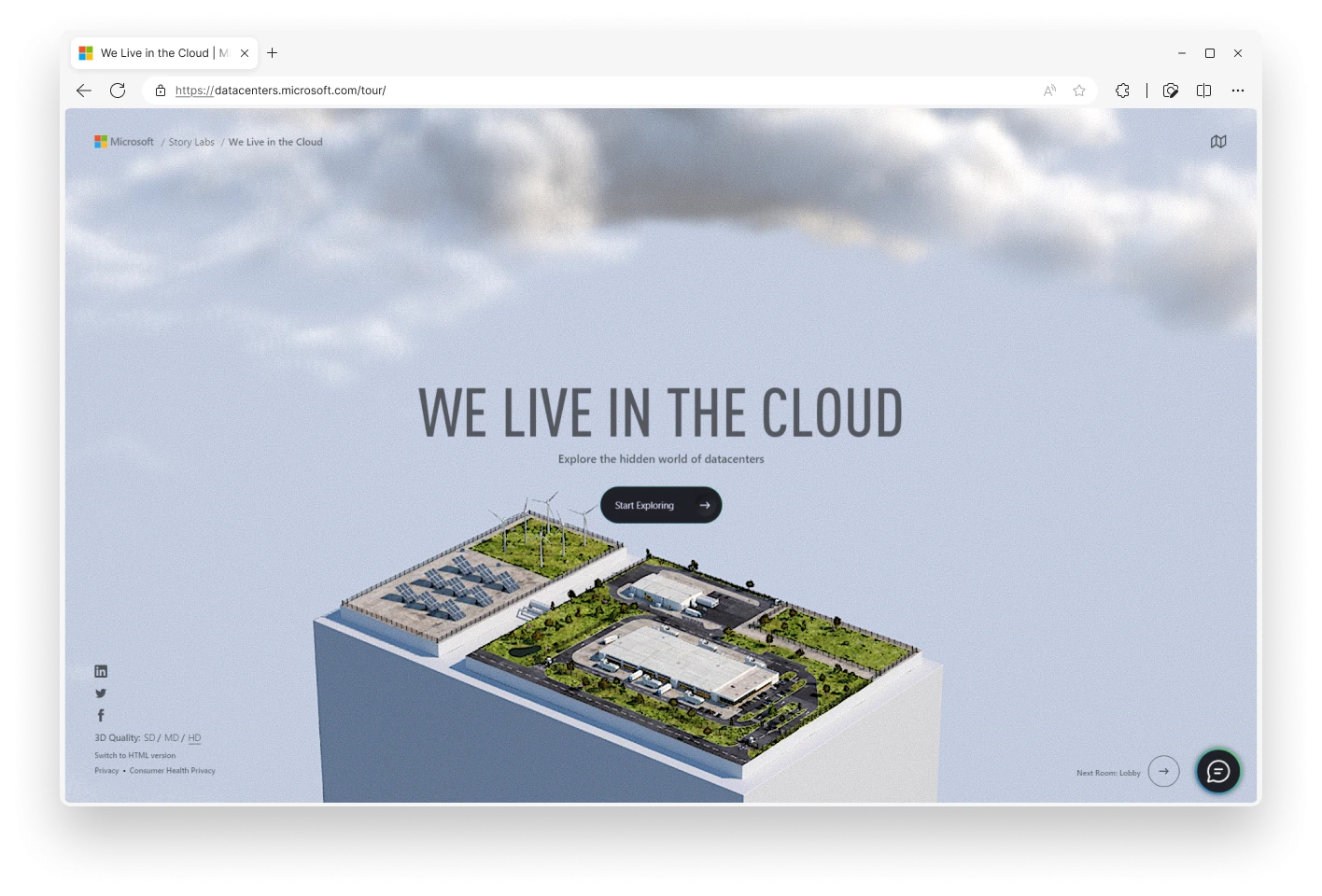
Nuestro recorrido virtual por el centro de datos es un micrositio que ofrece un viaje virtual autoguiado inmersivo en 3 dimensiones que les permitirá interactuar con los centros de datos de Microsoft de primera mano. Los visitantes virtuales aprenderán sobre la infraestructura necesaria para diseñar, construir y operar nuestros centros de datos, la energía renovable que los alimenta y el hardware y software que mantienen los datos seguros.
Un punto culminante del recorrido ofrece una visión del futuro del cómputo en la nube. La sala de innovación de nuestro recorrido virtual por el centro de datos les permite explorar innovaciones recientes como el diseño del centro de datos de refrigeración sin agua de Microsoft, que elimina el uso de agua en la refrigeración del centro de datos mediante tecnologías avanzadas, y Majorana 1, el primer chip cuántico del mundo impulsado por un núcleo topológico.
Este recorrido ofrece un adelanto de cómo Microsoft permite a millones de clientes ejecutar cargas de trabajo críticas y avanzadas, incluidas la IA y la computación cuántica, al tiempo que allana el camino para futuras innovaciones. Los visitantes pueden realizar el recorrido a través de una computadora personal o un dispositivo móvil.
Den un paseo por la nube con nosotros
Mejoramos de manera continua el recorrido virtual por el centro de datos con nuevas salas, contenido y experiencias para mejorar cada visita virtual.
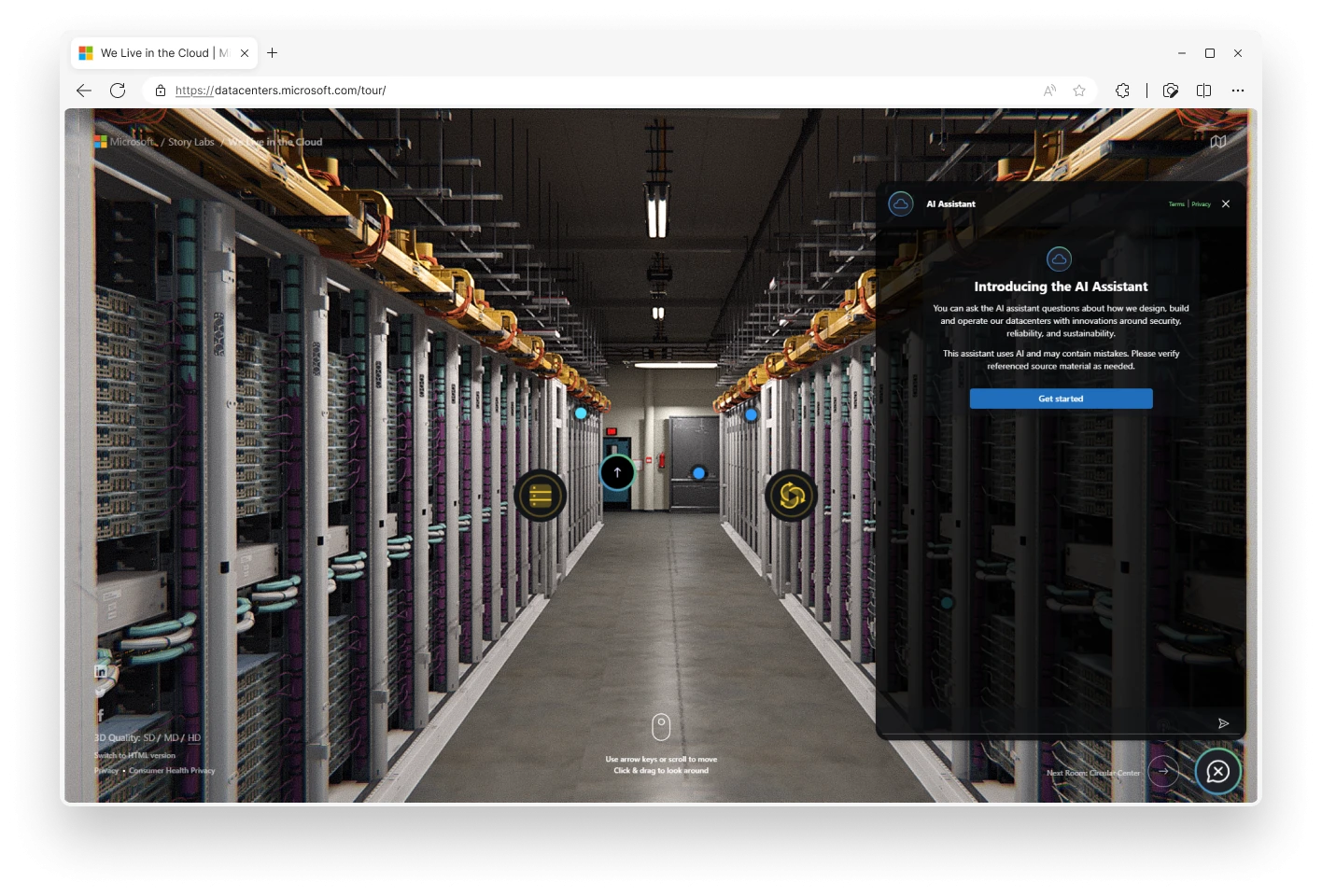
En primer lugar, nos complace anunciar la integración de un asistente virtual impulsado por el servicio Azure Open AI, diseñado para responder a las muchas preguntas que puedan tener. A medida que caminan por el centro de datos, serán recibidos por un asistente de IA que ofrecerá soporte en tiempo real durante su recorrido, para responder preguntas específicas del centro de datos y ofrecer información detallada sobre las operaciones de nuestro centro de datos. Ya sea que estén interesados en nuestras prácticas de sostenibilidad de la infraestructura en la nube de Microsoft, tecnologías de enfriamiento de aire, seguridad del centro de datos, capacidades de resiliencia o el alcance global de nuestros centros de datos, nuestro asistente de IA está aquí para guiarlos en cada paso del camino.
Exploren la sala de servidores y obtengan información sobre nuestro hardware más reciente, incluido Azure Cobalt, nuestras ofertas internas de computación general que impulsan la CPU, y Azure Maia, nuestro acelerador de IA personalizado optimizado para cargas de trabajo de IA. También tenemos asociaciones de larga data con líderes del sector como NVIDIA, AMD e Intel para garantizar que haya un conjunto diverso de hardware disponible en Azure. Esto nos permite ofrecer a nuestros clientes la combinación adecuada de rendimiento, eficiencia y coste.
Una novedad en nuestra sala de servidores es nuestra experiencia depasillo caliente. El diseño del pasillo caliente del centro de datos de Microsoft optimiza la eficiencia de enfriamiento al aislar el aire caliente de los servidores en un solo pasillo dedicado, lo que garantiza el máximo rendimiento y ahorro de energía. A más de 100 grados, el aislamiento único del aire caliente garantiza una temperatura constante, aumenta la eficiencia del enfriamiento, reduce el consumo de energía y reduce los costos operativos. Descubran cómo gestionamos una temperatura constante en nuestra sala de servidores al expulsar, e incluso reutilizar, el calor generado por estos servidores.
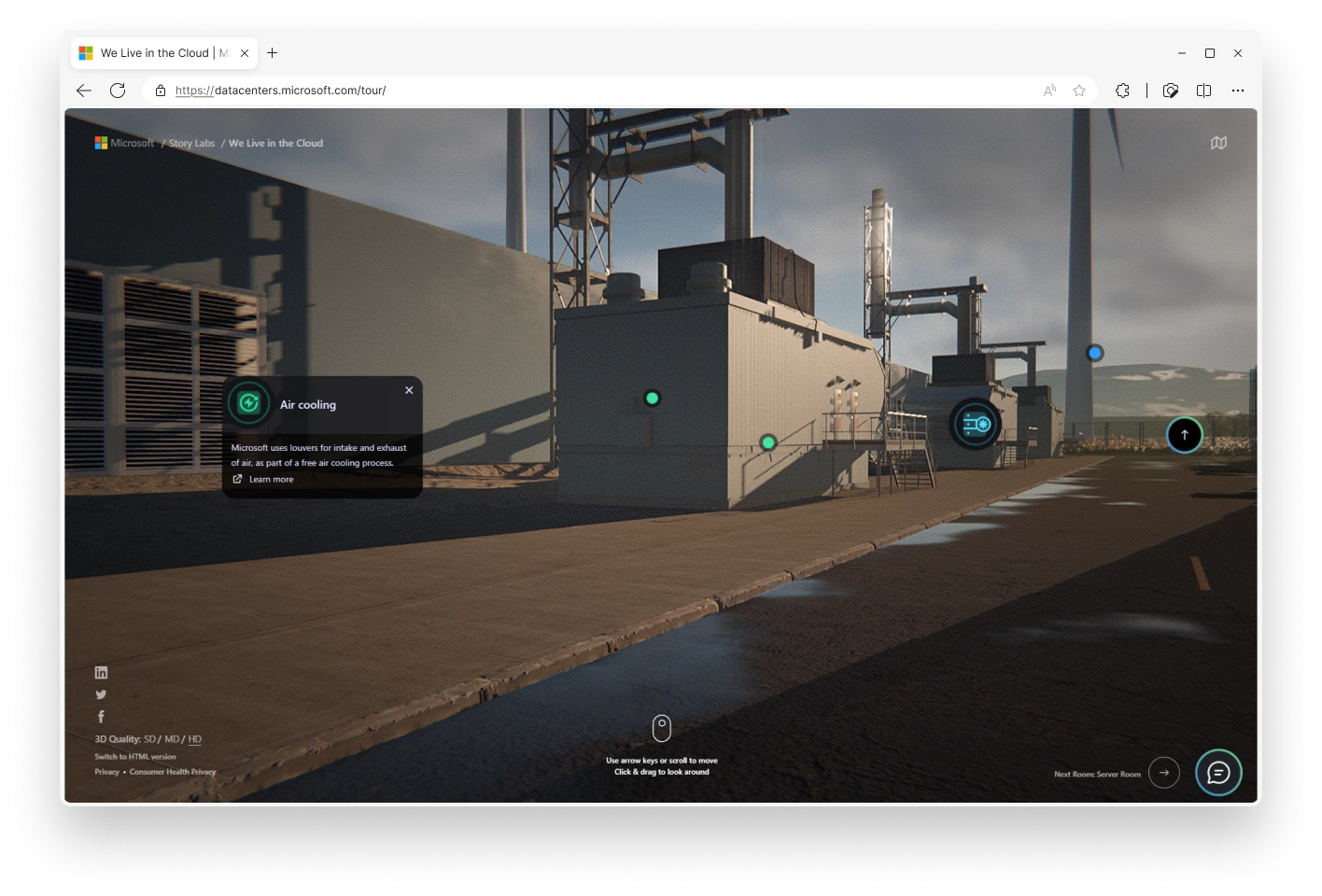
Si salen al área mecánica, se encontrarán con una amplia gama de tecnologías de energía y enfriamiento para centros de datos diseñadas por Microsoft. Desde el exterior, también verá una serie de equipos eléctricos, como baterías y generadores de respaldo, necesarios para alimentar el centro de datos en caso de un corte de energía. Las baterías y los generadores desempeñan un papel clave para permitirnos ofrecer la continuidad del servicio. Por cada megavatio de capacidad del centro de datos, por lo general tenemos poco más de un megavatio de respaldo de batería y respaldo de generador para asegurarnos de que los centros de datos puedan cumplir con nuestros niveles de servicio y confiabilidad operativa. A largo plazo, el objetivo de Microsoft es utilizar más combustibles bajos en carbono, baterías o incluso pilas de combustible de hidrógeno para generadores de respaldo.
En el exterior, también aprenderán cómo enfriamos nuestro centro de datos para garantizar la fiabilidad del hardware que se ejecuta en su interior. Si hace demasiado calor en el interior, los servidores pueden empezar a fallar. Para evitar que esto suceda, utilizamos enfriamiento adiabático y enfriamiento por aire libre. El enfriamiento adiabático y el enfriamiento por aire libre son métodos de una alta eficiencia para enfriar los centros de datos. El enfriamiento adiabático utiliza la evaporación del agua en lugar del aire acondicionado mecánico, mientras que el enfriamiento por aire libre aprovecha los elementos climáticos naturales para controlar la temperatura. Ambos métodos reducen de manera significativa el uso de agua y energía. Obtengan más información sobre la refrigeración del centro de datos moderno de Azure.
Visiten nuestro recorrido virtual por el centro de datos hoy mismo
Este recorrido virtual por el centro de datos enfatiza el compromiso de Microsoft de permitir cargas de trabajo avanzadas e innovaciones futuras. Experimenten un recorrido más interactivo e informativo con nuestra tecnología de IA de vanguardia y capacidades de diseño únicas actualizadas para comprender cómo Microsoft está a la vanguardia del futuro de la computación en la nube.
Experimenten el recorrido virtual por el centro de datos hoy mismo.
Amazon Connect now allows you to track durations of holds initiated by individual agents in multiparty calling scenarios through the new Agent Initiated Hold Duration field on the contact record. This new field allows contact center managers to gain insights into hold patterns at the individual agent level during customer interactions. This also provides other benefits including better agent performance management, allowing managers to identify areas for improvement in call handling. Additionally, it helps in optimizing your customers’ experience by providing insights into hold patterns and durations across different agents and scenarios. This level of granularity in data can lead to more informed decision-making in workforce management and training initiatives.
Amazon Connect now allows you to track durations of holds initiated by individual agents in multiparty calling scenarios through the new Agent Initiated Hold Duration field on the contact record. This new field allows contact center managers to gain insights into hold patterns at the individual agent level during customer interactions. This also provides other benefits including better agent performance management, allowing managers to identify areas for improvement in call handling. Additionally, it helps in optimizing your customers’ experience by providing insights into hold patterns and durations across different agents and scenarios. This level of granularity in data can lead to more informed decision-making in workforce management and training initiatives. To learn more refer to our public documentation. This new feature is available in all AWS regions where Amazon Connect is available. To learn more about Amazon Connect, the AWS cloud-based contact center, please visit the Amazon Connect website.
AWS Key Management Service (KMS) is announcing support for on-demand rotation of symmetric encryption KMS keys with imported key material. This new capability enables you to rotate the cryptographic key material of Bring Your Own Keys (BYOK) keys without changing the key identifier (key ARN). Rotating keys helps you meet compliance requirements and security best practices that mandate periodic key rotation.
Organizations can now better align key rotation with their internal security policies when using imported keys within AWS KMS. This new on-demand rotation capability supports both immediate rotation as well as scheduled rotation. Similar to flexible rotation for standard KMS keys, this new rotation capability offers seamless transition to new key material within an existing KMS key ARN and key alias, with zero downtime and complete backwards compatibility with existing data protected under this key.
AWS Key Management Service (KMS) is announcing support for on-demand rotation of symmetric encryption KMS keys with imported key material. This new capability enables you to rotate the cryptographic key material of Bring Your Own Keys (BYOK) keys without changing the key identifier (key ARN). Rotating keys helps you meet compliance requirements and security best practices that mandate periodic key rotation. Organizations can now better align key rotation with their internal security policies when using imported keys within AWS KMS. This new on-demand rotation capability supports both immediate rotation as well as scheduled rotation. Similar to flexible rotation for standard KMS keys, this new rotation capability offers seamless transition to new key material within an existing KMS key ARN and key alias, with zero downtime and complete backwards compatibility with existing data protected under this key. On-demand key rotation is available in all AWS Regions, including the AWS GovCloud (US) Regions and in the China Regions. To learn more, see the AWS Security Blog for how to use on demand rotation with imported keys, and the rotate on-demand topic in the AWS KMS developer guide.
Today, we are announcing the availability of AWS Backup in the Asia Pacific (Taipei) Region. AWS Backup is a fully-managed, policy-driven service that allows you to centrally automate data protection across multiple AWS services spanning compute, storage, and databases. Using AWS Backup, you can centrally create and manage backups of your application data, protect your data from inadvertent or malicious actions with immutable recovery points and vaults, and restore your data in the event of a data loss incident.
You can get started with AWS Backup using the AWS Backup console, SDKs, or CLI by creating a data protection policy and then assigning AWS resources to it using tags or Resource IDs. For more information on the features available in the Asia Pacific (Taipei) Region, visit the AWS Backup product page and documentation. To learn about the Regional availability of AWS Backup, see the AWS Regional Services List.
Today, we are announcing the availability of AWS Backup in the Asia Pacific (Taipei) Region. AWS Backup is a fully-managed, policy-driven service that allows you to centrally automate data protection across multiple AWS services spanning compute, storage, and databases. Using AWS Backup, you can centrally create and manage backups of your application data, protect your data from inadvertent or malicious actions with immutable recovery points and vaults, and restore your data in the event of a data loss incident. You can get started with AWS Backup using the AWS Backup console, SDKs, or CLI by creating a data protection policy and then assigning AWS resources to it using tags or Resource IDs. For more information on the features available in the Asia Pacific (Taipei) Region, visit the AWS Backup product page and documentation. To learn about the Regional availability of AWS Backup, see the AWS Regional Services List.